
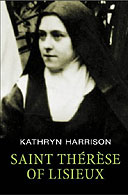
Saint Thérèse of Lisieux
Kathryn Harrison
224pp, Weidenfeld, £14.99
Kathryn Harrison begins her biography of Saint Thérèse of Lisieux with a fanfare, promising you a tale filled with wild hopes and bleak anguish, a heroine with a great will and a "violent", "annihilating" view of religion. But her subject doesn't live up to her promises, because St Thérèse is the dullest of saints, a bourgeois girl who became a nun at 15 and died in the convent at 24, in 1897.
Her bestselling autobiography, The Story of a Soul, was published posthumously and started the inexorable process towards her canonisation. And yet it is striking not for being violent and wild, but for being so sentimental and diminutive. St Thérèse's religion is a sugary one, filled with images of flowers; she called her doctrine the "Little Way" and wanted it to be for "little souls" who desired a "spiritual childhood".
Harrison keeps emphasising how much Thérèse Martin struggled for her vision, but in fact it seems as though her path to sainthood was remarkably serene from the start. She was a priggish little girl who kept a chaplet in her pocket at the age of three - three! - so that she could move a bead along whenever she made a small sacrifice.
She was a loner who never liked playing with other children, both her parents had attempted the religious life, and all her four sisters became nuns - so nothing was ever allowed to break through the claustrophobic piety in her home.
Because Thérèse wanted to enter a convent at the early age of 15, she asked permission from the Pope. Once permission was granted, she was told to wait for three months - which Harrison describes as a "torturous postponement, a sacrifice of such magnitude that she could take pride in providing this worthy dowry of suffering". This is typical of Harrison's breathless style, but, of course, Thérèse knew she would get there in the end.
In the absence of any extraordinary works, biographers are thrown back on little actions. Thérèse was determined to be a genius of small sacrifices - taking a chipped jug rather than her favourite one, accepting a rebuke for something she didn't do, and so on - and consecrated all those sacrifices to God. Harrison takes such actions at St Thérèse's own valuation.
For instance, one Christmas when she was 13, Thérèse didn't cry when she heard her father saying that he hoped she would soon be too old for presents. Harrison goes so far as to describe this self-mastery as an example of "transcendent power", a "night of illumination"; the problem is that such rhetoric outruns the moment itself.
Other writers have dealt with Thérèse without being quite so overwrought. Vita Sackville-West caustically described her as the "lowbrow" saint, and in a biography published in the 1980s, Monica Furlong argued that there was nothing special about Thérèse, and that this very mediocrity was vital to her appeal.
Thérèse's submission to this ideal of a life lived through little, everyday sacrifices was just right - as Harrison points out - for the world at the end of the 19th century, when men were troubled by the way that women seemed to be resisting this confinement to little deeds.
But such a submissive, even masochistic personality tends to raise ambivalent feelings in modern, sceptical readers and I wanted Harrison to confront that ambivalence. Perhaps if Harrison had explored what drew her to Thérèse, this book would have been more alive.
One answer, it seems, lies in Harrison's own life. In her memoir Seeking Rapture, she mentions how she followed her mother into the Catholic church when she was 12 and became a particularly pious, obedient child. Harrison adored her mother, who died when Harrison was 24, and she must have sympathised hugely with Thérèse's loss of her beloved mother when Thérèse was still a child.
Frankly, I hated St Thérèse when I first read her Heepishly humble memoir, and I felt no warmer towards her after reading this uncritical biography. If there is anything violent in her tale, it is the violence carried out by religion and tradition on a reasonably intelligent woman, who never allowed herself to grow up or live in the world because she believed that she could best please her God by remaining a cloistered child.
· Natasha Walter is the author of The New Feminism (Virago).
