
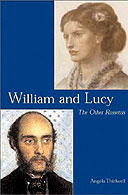
William and Lucy: The Other Rossettis
Angela Thirlwell
352pp, Yale, £25
Although the Rossettis have always seemed like the Pre-Raphaelites' reigning dynasty, it is Christina and Gabriel, saint and sinner, poet and painter, who have tended to hog the limelight. By the time younger brother William was born in 1829, all the family roles had been assigned and all the genius handed out.
It was left to William to be the recording angel of his siblings' stunning talent. While they sweated and moped over their respective arts, it was his job to explain Pre-Raphaelitism to the world by means of his journalism and critical reviews, which appeared in both the Academy and the Athenaeum. As if that weren't enough, he had been pushed to go out to work from an early age, his salary from the Excise Office being put towards the talent (and chloral habit) of his exalted elder brother.
Remarkably, William Rossetti does not seem to have been bitter about being sidelined before he was born. Perhaps the unhappy temperaments of his creative siblings - Christina depressed, Gabriel drugged - convinced him that there were better ways to participate in the nation's cultural life and still stay sane. His art writing was adventurous and fair, open to the new without being modish. Before long he was being consulted by collectors and called as an expert witness to arbitrate on such ticklish matters as whether Whistler's avant-garde Nocturne in Black and Gold was art or simply a nasty mess. Still, he managed never to stray far from the Rossetti mother ship: with Gabriel and Christina's early deaths in 1882 and 1894 William became the acknowledged keeper of their flames, collating successive editions of their major works and writing the first, and still useful, biography of his brother.
On one occasion when he went further afield for a subject, he picked Dr John Polidori, Byron's suicidal doctor, who was there the night Mary Shelley dreamt up the idea for Frankenstein. True to form, it turned out that Polidori was actually his uncle.
Rossetti's late marriage to Lucy Madox Brown in 1874 united two of the starriest family names in the Pre-Raphaelite firmament. Lucy's father was Ford Madox Brown the painter of pieces such as The Last of England and The Execution of Mary Queen of Scots which held scrupulously true to the early Pre-Raphaelite Brotherhood's commitment to realism and fidelity to nature.
Motherless from an early age, Lucy became an artist by accident in 1868 when she stepped in to complete an unfinished picture by her father's studio assistant. Until that point no one had noticed that she had any talent at all. From there Lucy pursued her craft carefully, producing paintings such as Romeo and Juliet in the Tomb and Ferdinand and Miranda Playing Chess which never quite got the credit or attention they deserved (critics liked to sniff that you had only to look at one of Miss Brown's pieces to spot immediately which of her father's paintings she was holding in her head).
The marriage of these two minor Victorians was as happy as it could be given the way that illness and its sorrows hugged them close. Apart from William's fraying family - his father, brother and sisters all declined into early deaths - there was the matter of Lucy's tubercular lungs. Much of her last decade was spent in a desperate search for health - odd diets, quack cures and sudden dashes for sunshine to Bournemouth, the Pyrenees and eventually San Remo, where she succumbed at the age of 51.
William carried on alone until 1919, a sturdy workhorse bearing responsibility not only for his own four surviving children but also for a host of other Pre-Raphaelite waifs and strays (the Brotherhood was not, as a whole, very good at looking after its own).
What makes Angela Thirlwell's book so exceptionally interesting is the way it challenges the orthodox - and by now rather worn - biographical template. Refusing to pursue the usual biological timeline, Thirlwell offers instead a series of soundings or, to use her phrase, "spots of experience" in William's and Lucy's lives. Thus there are discrete sections on William as a Victorian salary man; Lucy's edgy relationship with her saintly sister-in-law Christina; William as art critic; Lucy as dying swan.
It is a testament to Thirlwell's skill as a planner and grace as a writer that the narrative pulse of The Other Rossettis never weakens. Indeed, by side-stepping the requirement to plod day-by-day through her subjects' lives, she manages to avoid much of that quotidian detail that can make reading biography such a slog. As a result, what might have been a so-what story about two Victorians with famous relatives becomes a wonderfully illuminating study of a whole slice of 19th-century cultural, social and intellectual life.
Kathryn Hughes is writing a biography of Mrs Beeton.
