
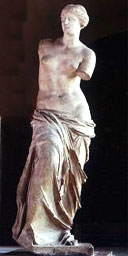
M. Théophile Gautier relates in the Journal Officiel how the "Venus of Milo" was saved from the Prussians and the Communists. At the beginning of the war, he says, when the first defeats showed that Paris was in danger of being besieged, the most valuable of the pictures in the Louvre were taken out of their frames and sent to Brest; but it was not so easy to find a place of security for the statues, whose weight and fragility made it impossible to pack them properly for so long a journey.
Among these statues by far the most valuable was the "Venus of Milo" and "he thought that this adorable work or art might become Prussian filled our connoisseurs with dismay". At last, after giving much thought to the subject, the guardians of the Louvre hit on an ingenious means of getting out of difficulty. The statue was taken down from its pedestal and laid in an oak coffin filled with wadding. In the dead of night some men who could be depended upon brought the coffin with its precious contents to a secret door in the Louvre, where it was taken up by some others and carried to a spot known only to themselves, where a crypt had been prepared for the goddess in the cellars of the Préfecture de Police.
"What a grand poem," observes M. Gautier, "would Heine, the singer of the banished gods, have written on the nocturnal burial of this most famous of immortals, and what ironical apostrophes he would have directed against those hordes of the followers of Kant and Hegel, at whose approach a dweller in Olympus fled to the Rue Jérusalem!".
The hiding place was at the end of one of the numerous secret passages in the Préfecture. A wall was built in front of the spot where the Venus was laid, and covered over with rubbish, so as to give it the appearance of antiquity. To make assurance doubly sure, a heap of documents of some importance was laid in front of this wall, and a second wall was then run up, so as to make it appear that the hiding place was made for the documents.
Here the Venus remained during the whole period of the siege, her admirers wondering all the time what had become of her. Perhaps, says M. Gautier, she found her seclusion rather tedious; but time is of no consequence to an immortal, and she must have been accustomed to darkness by her confinement of several centuries in the vault from which the Greek peasant Gorgos extricated her.
· This article is drawn from the archive at the Newsroom
