
Bright Earth: The Invention of Colour
Philip Ball
434pp, Viking, £18.99
Blue: The History of a Colour
Michel Pastoureau
216pp, Princeton, £24.95
Grains of sand grit the ground of a Monet seascape, proving that he really did paint in the open air. The oil that was the slow-drying medium for his pigments was a Flemish-Italian development of the 15th century, releasing art from the plastered wall, wooden panel and vellum manuscript page to a lightweight canvas. The collapsible tin tube in which to transport oil paints was an 1841 invention, replacing pigs' bladders. And the pigments suspended in Monet's oils were a vivid history of the world's capabilities and desires.
Monet proclaimed that the "true colour of the atmosphere is violet - fresh air is violet", and to show it, he used cobalt and manganese violet pigments devised by chemists in the 1850s and 1860s. He also squeezed cobalt and cerulean blues, synthetic ultramarine, emerald green - French emerald, not the arsenical British wallpaper colourant that poisoned babes in their beds - viridian, chrome yellow and a crimson lake based on an aniline dye, all of which had been confected for the first time within the era of steam power. Only his vermilion red, an alchemical synthesis of sulphur and mercury, would have been familiar to a medieval artist. He did, however, use as a mixer lead white, which the Egyptians manufactured 2,000 years ago, with vinegar for acid and dung for carbon monoxide, rather than the new non-toxic zinc white. This was still expensive, although soon to be produced so cheaply that it replaced lead even for painting picket fences.
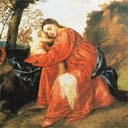
Brilliant, eh? In every sense. Ball's book is the volume that has been missing from my library; in it the sciences of colour are followed chronologically, making clear what was chromatically possible to artists at any time. I have shelves of books about colour theory, what Newton perceived through prisms and Goethe registered on his retina in the afterglow, but no other work that explains why Titian rendered the robe of the cymbal player in his Bacchus and Ariadne an amazing orange. Because, it delights me to find out, he was Venetian, and unconstrained by conventions, vigorously fingering oils on expanses of sail canvas easily bought in a port. He had access to imports, probably Egyptian, of the arsenical sulphide realgar (the only proper orange until Nicolas Louis Vauquelin cracked open the Siberian crystal crocoite and from a new metal discovered within it liberated chrome orange). And because he was Titian, of course, with his gloriously hued view of beauty.
Ball constantly balances the artist's vision, what was available with which to realise it, and what the result meant in prestige and years off purgatory to the patrons who paid the pigment bills. I've bought stones smuggled out of the Afghan mine that supplied dynastic Egypt with its lapis lazuli and clothed 14th-century Madonnas in robes of ultramarine blue: the expensive mineral is a marvel, a chip off a late evening sky in summer, and in Gothic art only the secret-recipe vermilion had equal power, once both were fine-ground and bound hard with egg yolk. Later, Vermeer's trio of harmony was based on ultramarine, plus a clarion yellow and the pearly calm of white lead: he gives tranquillity and dignity to his maidservant pouring milk by blueing her apron, in life likely dyed with workaday woad, with the ultramarine of Mary's mantle, 45 guilders the ounce minimum.
Primaries do not convey all the passion, though. There were new colours around in the Dutch golden age, synthetic iron oxides called Mars pigments, suited to a warlike Europe, to be fashionably gloomed with bituminous browns and varnished with honeyed tars. Not that Rembrandt achieved his warmth of wisdom with a coat of modified asphalt. Ball analyses a wall in shadow in the background of a Rembrandt portrait; its lighter part is underpainted with red and yellow earths mixed with bone black and lead white, glazed with smalt (blue from crushed glass), red ochre and yellow lake. The deep darkness is washed over with bone black, red lake and ochre. By Rembrandt's ruined end, all he had to work with were a few cheap, earthy tones, yet he still blended them with that fervent concern for the permanent that he had admired in Titian.
I ought to pay dues to Michel Pastoureau's book, which has the many large, gorgeous reproductions that Ball lacks (Ball's are carefully chosen and accurate, but about the size of commemorative stamps); however, it expends words on methodology in its preface, and does not perk up much thereafter. There was a point at which I was gorging on Ball writing about blue (he allows himself a monochrome chapter on the colour because, as Yuri Gagarin said, seen from space, the earth is blue), while referring to illustrations in Pastoureau - the Wilton Diptych on the cover, in that heavenly ultramarine again - and then returning to Ball's entries on colour printing to understand how Pastoureau's plates approximate the differences between azurite and Prussian blue.
Pastoureau barely contemplates art's practicalities, only what he considers colour should signify (he has interesting divertissements on the history of white and red flags - the red was a royal stop sign to riots that revolutionary mobs grabbed and adopted). But he so often mentions shades, French blues since he's a cultural chauvinist, with hardly a footnote's-worth of technical information. Who invented the printing ink for Gauloise cigarette packets, then? Who concocted the half-camouflage horizon blue of first world war French uniforms, and could its paleness have been related to the German chemical giants' monopoly on synthetic indigo?
I bet Pastoureau lives in, as they say, a space decorated with the 20th century's pushy superwhite, titanium, which left gentle zinc and archaic lead so far behind. Not a man to appreciate the true hero of polychrome, J M W Turner. Ball goes as far as abstractionists and hard-edgers and those late-20th century artists who bought their enamel from Woolworths, but his most modern and memorable passage is the description of Turner's daring "avid appropriation" of experimental pigments lately extracted from the new prismatic metals. Turner bought them off the colourist George Field so fast that Field hardly had time to test them for durability (and many failed, blackened or splotched).
On varnishing days at the Royal Academy, Ball describes in awe, other artists brought their finished works to retouch. Turner arrived with dull canvases, hung them next to those of his rivals, and got to work "piling on all the brightest pigments he could lay his hands on" - barium chromate, scarlet, and other stunning novelties later taken up by the Pre-Raphaelites, Impressionists and Fauves. Once he added a sole dab of red lead to a drab seascape, it sang - outsang the vermilion and red lake in an adjacent Constable. "He has been here and fired a gun," said Constable bitterly. Wow.
