
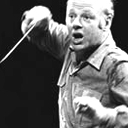
It is 18 years since Bernard Haitink last conducted the Royal Concertgebouw in London. This seems astonishing. Haitink was the orchestra's chief conductor from 1964 to 1988, and the Concertgebouw is the ensemble with which his name will remain irrevocably linked. This is not to disparage either his subsequent achievements elsewhere or the orchestra's equally astonishing later work under Riccardo Chailly. But Haitink's partnership with the Concertgebouw was one of those musical associations that ultimately defined the profile of both conductor and orchestra.
One of Haitink's great achievements was his effective restoration of Mahler to a dominant position. A key composer in the Concertgebouw's repertory, Mahler was often deemed an unknown quantity elsewhere until Haitink reasserted his significance. It was to Mahler's Sixth Symphony that he returned on this occasion. His interpretation has become more uncompromising with time. The Sixth is stalked by ideas of death and a malign, deterministic destiny, though it lacks the catharsis and resignation that characterises the genuinely tragic statement of the Ninth. In their place, we find nihilistic despair, morbid humour and a mix of terror and disillusionment.
In Haitink's interpretation, even the work's moments of lyricism proved brief and illusory. The rapturous second subject of the first movement was undermined by the shrieking piccolo doubling the theme. Haitink emphasised the weird melodic jolts of the slow movement, reminding us that its theme, even after repeated hearings, never quite takes you where you expect. Elsewhere the music erupted with ghastly force. The marches had a relentless, motoric precision, while the mock-baroque posturing of the scherzo seemed moribund. The fate theme, with its simple, yet disturbing harmonic shift from major to minor, crept in with sardonic irony, becoming more alarming with each repetition. The playing was exceptional, and the whole performance was fairly devastating. When it was over, the audience refused to let Haitink and the orchestra go. The force of their partnership shows no sign of abating.
