
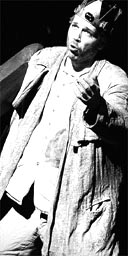
photo: Tristram Kenton Photograph: Tristram Kenton
"Time becomes space here," Gurnemanz tells Parsifal as he leads him to the Grail hall in the first act of Wagner's music drama. The significance of the line, like everything else in the work, has been hotly disputed. Claude-Lévi Strauss argued that the phrase constituted the essence of myth as the embodiment of an essential truth beyond time and space, and Wagner's sickly amalgam of Christian and Buddhist thought has often been interpreted as conveying the universal essence of redemptive spirituality and religion. This isn't quite true. Redemption is confined to a small, male, elected quasi-military elite obsessed with an ethic of purity. Wagner equates the forces of destruction with disease and physical imperfection. It's not surprising that Parsifal has also been dubbed the most proto-fascist of Wagner's works.
Klaus Michael Grüber's new Covent Garden production messily probes these contradictions. The first act is fine. Time and space genuinely seem to blur. The images of decay are shocking. The Grail forest suggests both a vista of dead trees and a soul-destroying inner-city landscape of concrete columns and wires, where John Tomlinson's touching Gurnemanz reminisces with mystic fervour about the community's pre-lapsarian state. Amfortas - Thomas Hampson giving a towering performance - is a ghastly icon of mutilation, tottering through this landscape supporting himself on a crutch-like prosthetic arm. The Grail knights sit like living corpses at the communion table, their faces a livid yellow.
When we get to the second act, however, things go wrong. Grüber portrays Klingsor's world as surreally formless in contrast to the decrepit rigidity of the knights, though it gets silly. The enchanted castle is a hall of mirrors, with a stuffed shark swinging Jaws-like from the ceiling. Parsifal's seduction seems to take place in a fish tank. Stig Andersen, incisive and disturbed as Parsifal, and Violeta Urmana's tangily voluptuous Kundry sing as if their lives depended on it, though the staging fails to generate much erotic charge. The last act doesn't regain the necessary momentum after this lapse - and, as so often with Parsifal, we are left with a gulf between staging and music.
The actual performance, however, is second to none. It's conducted by Simon Rattle, whose interpretation has deepened since he last performed the work in London at the Proms two years ago. His detached cool on that occasion has now become a fierce engagement with the score. The mixture of genuine spiritual fervour and queasy sensuality is immaculately judged, while the numinous quality of Wagner's music leaps out of every bar. The choral singing is consistently beautiful and the playing, all sensual strings and vibrant, noble brass, is outstanding. You need to hear this, no question - though you also need, occasionally, to turn a blind eye to what is happening on stage.
· At the Royal Opera House, London WC2 (020-7304 4000) until December 22.
