
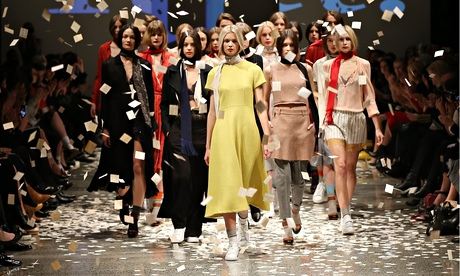
At the recent New Zealand fashion week, designer Kate Sylvester unveiled Tartt, her new AW15 collection inspired by author Donna Tartt. Along with everyone else, Sylvester read the Pulitzer prize-winning The Goldfinch over the summer, and created a fashion collection inspired by the book’s descriptions of ethereal beauty and Manhattan high fashion.
Additionally drawing on aspects of her 1992 debut novel The Secret History and the author’s own style, the clothes in Tartt are elegant in a Waspy sort of way, all fine knits, silk scarves and red lips. But what would it look like if other authors’ work was transposed on to the catwalk?
Martin Amis
The clothes The “London Fields” womenswear collection would be based on a high-class escort aesthetic: scarlet bodycon dresses, black lace, vertiginous stilettos. The menswear would include bomber jackets and tracksuit bottoms, adorned with the occasional gold chain in a muddled attempt to portray working-class style.
The vibe The venue would exude the faded grandeur of a late-night west London pub: dark polished wood, dartboards and dim chandeliers, suffused with an undercurrent of sleaze and stale beer. Crumpled £50 banknotes would be scattered around the room with women’s numbers scribbled on them.
Margaret Atwood
The clothes To illustrate Atwood’s wide-ranging career, a mix of full-body capes (The Handmaid’s Tale), tattered but futuristic-looking rags (MaddAddam), and pretty 1930s-style flapper dresses (The Blind Assassin).
The vibe Sirens would blare in the background, interrupted by sudden loud noises and foghorns. Noxious-looking green fumes and motorised flying pigs would float around the air. On arrival, guests would be divided into tribes, put in a hierarchy, and told to fight one another for the best seats.
Paul Auster
The clothes: Black turtleneck sweaters and dark jeans under fitted trench coats and leather jackets, accessorised with black-rimmed glasses and copies of The New York Trilogy. The models’ facial expressions would range from “neutral” to “blase”.
The vibe: Quotes from Derrida and Baudrillard would light up the walls, while guests would be presented with mandatory espressos and cigarettes. W ords such as “existentialism” and “intertextuality” would randomly flash on to the backdrop.
Franz Kafka
The clothes: An endless procession of men in identical grey suits. These would be neither well-cut nor particularly shabby, forming an amorphous sea of unmemorable fabric. The models would be chosen based on how generic their features are, yet there would be something sinister lurking behind their cold, dead eyes.
The vibe: In order to gain admittance to “The Trial”, guests would have to fill out a variety of forms asking tautological questions, be interviewed by a succession of bureaucrats, and repeatedly denied entry. When finally allowed in, they would be subjected to random checks and intimidation by roaming guards.
