
Kevin Maher’s debut, The Fields, published in 2013, tackled the most shameful episode in modern Ireland’s history: clerical sexual abuse. It did so in a way that was funny, convincing, moving and uplifting. Not since Patrick McCabe published The Butcher Boy more than 20 years previously had such darkness been combined with such humour. What made both books remarkable were their extraordinarily endearing narrators: hopelessly trammelled – and yet somehow still innocent – child-men.
The Fields was channelled entirely through a first-person narrator, 14-year-old Jim. Maher’s second novel, Last Night on Earth, takes a more scattergun approach. It opens in London in 1996 with a birth scene told in the first person by the baby being born (“my head, lolling out of skin stretch with body tummy crushed inside”) before Jay, the baby’s father, emerges as the main character. His third-person narrative occasionally veers into first person and back for reasons which are not entirely clear, and we have direct access to his inner world through the letters he composes “in his head” to his mother (“Mother of Jay”) who is back home in the “Land of Jay” – Ireland.
Unlike Jim from The Fields, Jay is not a child, but he is an adult who hasn’t quite grown up. He left rural Ireland as a traumatised teenager in the early 1990s, when his mother, “a consummate yarn spinner” in the throes of Alzheimer’s, had declared her son a virgin birth, “the second coming of Christ”. Having failed to finish school, he finds work on building sites before a chance opportunity allows him to become a documentary-maker.
By 1999, Jay is a separated father. His Irish-American wife, Shauna, has left him for her psychologist, Dr Ghert, who has been treating her for postnatal depression. Shauna and Dr Ghert’s story is told through their patient/doctor conversations. We discover that Bonnie – Jay and Shauna’s daughter who narrated the opening chapter – may have been damaged by her botched homebirth: “it’s all dyspraxia this, severe gross motor skill delay that”.
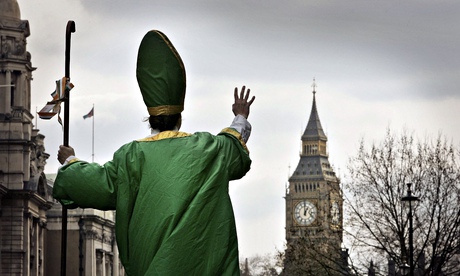
Meanwhile in the Land of Jay, preparation for the end of the world – the “Millennium Apocalypse” – is under way. The Mother of Jay’s claim that her son was the Second Coming has piqued the interest of the local bishop. With a view to recruiting more souls to the Catholic Church, he offers Jay “a hefty retainer … to secure [his] services, effective almost immediately, as the one true and risen Christ”. But just as this plot strand veers into ethnic slapstick, the bishop and his retinue pitch up in London on a mission that casts a different light on Jay’s wellbeing.
Irish words are sprinkled throughout Jay’s sections, yet he spells them phonetically in his letters to his mother, which seems illogical, as she would speak Irish too. Thus, the reader is presented with formulations such as “fawlcha go hairin”: this means nothing to an Irish speaker until spoken aloud, whereupon it reveals itself as Fáilte go hÉireann: “Welcome to Ireland”. It means even less to a non-Irish speaker, since a phonetic spelling can’t be looked up in a dictionary. The novel seeks continually to explain Irishness; freighting Jay’s voice with these explanations is cumbersome, yet to have to perpetually explain oneself is part of the immigrant’s condition. Maher writes well about what Jay terms the “immigrant’s dilemma”: “the desperate beauty of all things left behind”, the ache of the soul when one is caught off guard and “look[s] around for Ballaghaderreen and Claps and the lads and yet your mind finds nothing, you recognise nothing around you, the streets make no sense”.
At its heart, Last Night on Earth is the story of two people who are very much in love and should be together, but whose marriage buckles under the strain of having a baby who may or may not have a disability. Jay and Shauna’s struggle makes for compelling reading, and their anxiety over the welfare of their precious child will find resonance with every parent. Maher writes most powerfully when he is depicting the big emotions, love in particular – romantic love, filial love, parental love, the love between friends. “What you’ll find in me, Mammy, is a … fella, most of all, who understands and believes in the transformative power, both in emotional contexts and within the very physicality of the human body, organs and all, of love itself.” Maher’s rowdy and multicultural cast occasionally risks overwhelming Jay and Shauna’s story, though perhaps that is Maher’s point: sometimes, with the best will in the world, life gets in the way.
• Claire Kilroy’s novels include The Devil I Know (Faber).
• To order Last Night on Earth for £11.99 (14.99) go to bookshop.theguardian.com or call 0330 333 6846. Free UK p&p over £10, online orders only. Phone orders min P&P of £1.99.
