
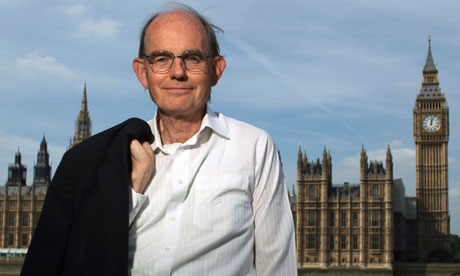
The publicity campaign for Chris Mullin's second volume of diaries is, given this week's literary competition, nothing if not heroic. "Is A Journey making you travel sick?" asks the Profile Books' blurb, enticingly. "Try Chris Mullin's Decline & Fall, the refreshing antidote to Tony Blair!" "We always knew Blair's book would be coming out the same week so the publishers decided to make a virtue of it," says Mullin.
We're standing outside the Palace of Westminster, hoping that 62-year-old Mullin, who was Labour MP for Sunderland South for 24 years until April, still wields enough clout to get us into the corridors of power. He has an out-of-date pass, no tie and the impish look of an old boy returning to school to stir things up. "Ah, they still know me," he says as we pass the security check. "I don't think we'll try for the terrace – it would be so humiliating if they wouldn't let us in." Instead we settle at a table at the cafe in Portcullis House. I'm sure he chooses his seat with a view to buttonholing passing old pals.
"Your book," announces a passing Sunday tabloid political correspondent, "has the virtue of being written. Have you read Blair's? It's Bridget Jones's Diary! Every sentence ends in an exclamation mark!" "I suppose," says Mullin, "he did write a lot of it on planes."
"Dear boy!" booms the cartoonishly rotund and plutocratic Nicholas Soames. Mullin, one-time hardcore Bennite socialist, scampers from our table to greet his Tory chum. It's a Little and Large moment, pure panto. "How is it here without me?" shouts Little. "Ghastly," retorts Large. Large strolls off in double-breasted pomp, shouting over his shoulder: "I've bought 30 copies of your book for friends."
That, I tell Mullin, will never be enough to rival Blair in the bestseller lists. "Nothing would," he says. Blair is donating his £4m-plus advance and any royalties to the British Legion. What are you doing with the money from your book? "I'm thinking of a conservatory." I don't know how much conservatories cost in Sunderland, where Mullin still lives, but that doesn't sound like the kind of advance that would have made his fellow diarists, Lord Mandelson or Alastair Campbell, power up their laptops. "My wife Ngoc, who's Vietnamese and generally speaks very good English, calls it a conservative." A conservative in Sunderland – nothing sounds so wrong.
But isn't a conservatory too little a reward for the sordid business of publishing a political diary? One of his leading critics, former Labour deputy leader Lord Hattersley, thinks so. "Roy doesn't think political diaries should be published. But then Roy has never liked anything I've ever done." Hattersley's Daily Telegraph review of the first volume of Mullin's diaries concluded: "Page after page exudes the conviction that he is morally superior to those around him." Does Mullin recognise himself in that assessment? "Of course not! Roy doesn't think politicians should publish diaries because they involve indiscretions," he says. "I can see his point on that."
The new volume offers disappointingly few indiscretions. Even my favourite revelation, that Cherie Blair was so disgusted at the decor in the prime ministerial nuclear bunker that she ordered it to be redone pronto, may not be true. "It may be that she saw the decor and didn't like it, but that the redecoration was done without her requesting it," clarifies Mullin.
Surely there's a deeper objection to political memoirs and diaries than Hattersley's. It is that both are the basest of bastard literary sub-genres, premised on megalomaniac insistence that the author shall write the last draft of history thus achieving closure and denial in one psychically questionable, rhetorically laughable and usually unnecessarily thick volume. Mullin demurs. "[John] Major's memoirs are terrific because he has a story to tell about a rise from nowhere. Thatcher's, even though very self-serving, are elegantly argued. Blair's is a rock-star memoir so it's in a different genre."
Political diaries are, Mullin insists, in any case different from memoirs. "The best are written by people who don't live in the light of the stratosphere, but glimpse it for a moment." People he means, like himself, and to a lesser extent Alan Clark. His favourite political diaries were written by Jock Colville, Churchill's wartime private secretary.
Surely then you must loathe Mandelson and Campbell's diaries because they were written in the stratosphere's blinding light? "I don't. Alastair's unexpurgated diaries are terrific."
Alan Johnson stops by our table. "I've kept a diary since I was 25," he discloses. "It makes interesting reading now – I was such a pompous fucking twat at 25." Not the kind of language that makes one think the shadow home secretary will publish.
Mullin has no such compunction. "I always knew I would publish the diaries because I am a writer while others have no such ambitions. The only question was when." Mullin decided to publish the first volume of his diaries, A View from the Foothills (which covers the period from 1999 to 2005 when he served in a series of junior ministerial posts), last year while still an MP. "By then, I'd decided I would stand down as an MP and I needed an exit strategy." Mullin says that his old friend Liz Forgan, former journalist and current chair of the Scott Trust (which runs the Guardian) and Arts Council England, told him over dinner to set something in place while still in parliament to catalyse a post-Westminster career. "With one daughter still at school and another at university, I need that career. So I published sooner rather than later."
His exit strategy has yielded some nice assignments. He's going to do a series of lectures at Newcastle University on the Labour party's postwar history. He is considering whether to be a Booker judge, freely admitting to be intimidated by how much reading that would involve. He's also plotting two books. The first will be another volume of diaries called A Walk-on Part and covering the period from John Smith's death in 1994 to the start of his ministerial career in 1999. "There is a precedent for publishing out of chronological sequence. Alan Clark did too."
He may also write a sequel to his 1982 novel, A Very British Coup, provisionally entitled The Friends of Harry Perkins (who was the book's Labour leader hero). Before we leave our cafe table, Mullin gets another gig: they want him to appear before the standards and privileges select committee to explore the proposition that there are too many ministers in Whitehall.
What made you decide to quit as an MP? "My wife is an interpreter but that job involves a lot of travelling and that couldn't be done with me as an MP. Also, when the expenses scandal hit, she felt politics had become terribly tarnished and I should get out."
Ngoc's hopes and fears can't be the whole story. Throughout Decline and Fall, Mullin appears as a man out of time and out of the loop. As early as June 2007, he writes: "I mustn't kid myself that I am doing anything very useful beyond acting as a glorified social worker. And far as the big picture is concerned I am entirely irrelevant. If I'm not careful I shall end my days as a tearoom bore, regaling anyone prepared to listen with tales of triumphs past." He has a particularly hideous realisation in September 2009 when he finds that David Cameron is proposing to cut back the government car service, inspired by Mullin's revelations about it in the first volume of diaries. "So, I do retain a smidgeon of influence. Alas, however, for the wrong party."
As for politics becoming tarnished by the expenses scandal, Mullin was famously one of the few MPs to emerge from it with reputation enhanced. While others had to cough up for claiming for TV porn, moat-cleaning and duck houses, Mullin was exposed as the owner of a black-and-white TV. "The licensing people send me letters warning that my licence cannot be used for colour TVs. They don't seem to believe that in the 21st century anyone has a black-and-white set."
Mullin argues the public have been ill-served by reforms to MPs' expenses. "MPs can no longer claim mortgage interest on their London properties, only rent. They could never claim, as some newspapers misleadingly claimed, capital payments on mortgages. But the rental value of my flat in London was £1,100 to £1,200 per month, while the mortgage interest only cost £235 per month. As a result of the changes, MPs are banned from claiming mortgage interest as an expense so they're obliged to rent, which often costs the public more. Quite mad."
Veteran Labour MP Frank Dobson greets Mullin: "I woke up to the sound of your book being read on the radio." Decline and Fall is Radio 4's current Book of the Week. Dobson can't, though, remember which passage it was that stirred him from his slumbers. I like to think it was one of the more waspish ones, such as the paragraph in which Mullin says he'd like to strangle Joanna Lumley for pointlessly getting Gurkhas hopes up of a better life in Britain. Or the Glenda Jackson barb: "Goodness knows what she won her Oscar for; certainly not charm." Or Mullin's assessment of Nick Clegg: "For all his fluency and self-confidence, Clegg is easily the biggest charlatan of the lot." Or his telling vignette of Gordon Brown returning from Buckingham Palace anointed as PM in June 2007: "He still doesn't look happy (what does it take to make Gordon happy?) and it takes a second or two for a smile to travel from Gordon's brain to his lips."
"So what about Blair, eh?" asks Dobson, sitting down. "Turns out we were wrong about fox hunting and he was right about Iraq." We fall to discussing the sex scene in Blair's rival book. On the night of 12 May 1994, when Blair was poised to stand as Labour leader, he "devoured" his wife's love, adding: "I was an animal following my instinct, knowing I would need every ounce of emotional power and resilience to cope with what lay ahead." "I wonder what kind of animal," asks Dobson. "A three-toed sloth?"
Mullin, though he has read A Journey, claims not to have come across this passage. He's more high-minded than Dobson. Perhaps if he'd put in a bit more raunch in his diaries he wouldn't have gone from his book signing at the Edinburgh festival to find that they had no copies of his book in the nearby Waterstone's. Mullin gives me his best withering look: "Not my style."
He refuses to bury Blair, though any praise is qualified: "My difference with Blair is that although I acknowledge he was a great leader, and one of our most successful, he linked us umbilically to the worst American president in my lifetime." He is mystified rather than angry about the post-2005 election reshuffle in which Blair dispensed with his services as Africa minister. "If I had one message to future prime ministers it is don't reshuffle so much. I did that job for two years and was only getting on top of my brief when they got rid of me."
We stroll through beautiful late summer sun over Westminster bridge for photos. I ask him about current political events. What's his take on the foreign secretary, William Hague? Did Hague have a relationship with his aide Christopher Myers? Does it matter if he did? "I know nothing about William's private life. This story is not in the public interest, except in so far as it involves employing someone on the public payroll with whom he may or may not have had a relationship. I don't know if any of that is true. But I do admire William greatly."
Why are you backing David Miliband for Labour leader? "Because he has more weight than his brother and represents our best hope of beating Cameron." Do you really think that Hilary Benn, who Mullin championed to be Blair's successor, would have kept Cameron out? "Probably not, but Hilary's such a lovely man."
Mullin is to give a lecture at Bristol University in the spring entitled In Defence of Politics. Tough gig. "I've given versions of it before, usually to boarding school children." What is the defence? "Never forget your good fortune that you have been born in a country when you turn on a tap, clean water comes out; if you flick a switch, you get electricity; if you don't like your political leaders, you can remove them without revolution. People in much of the rest of the world can't take any of those things for granted. But the reason for all of that is that you live in a democracy." Do you really believe all that? "I wouldn't have spent 24 more years of my life in there if I didn't."
Chris Mullin's book, Decline and Fall, is published by Profile
