
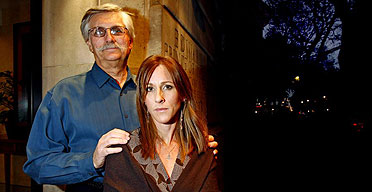
'People ask me if I'm vengeful," says Kim Goldman. "He stabbed my brother to death. He's living a life of luxury, playing golf, living in a mansion in Miami and wearing Rolex watches, while my brother is dead. Am I vengeful? Kinda."
The "he" is OJ Simpson, who on October 3 1995 was acquitted of murdering Kim's brother Ron Goldman and Simpson's ex-wife Nicole Brown Simpson in Brentwood, California, after one of the most controversial, compelling and repulsive court cases in American history. A year after that verdict, the victims' families brought civil cases against Simpson in which he was found liable for wilfully and wrongfully causing the deaths of Ron and Nicole and required to pay $33.5m (£16.1m).
Nobody in the Goldman family calls him OJ. "We only refer to him as 'the killer'," says Ron Goldman's father Fred, "never by name."
Thirteen years after the murders, both father and daughter have come to London for one of the most bizarre book tours ever mounted. The Goldmans, the victim's family, are promoting a book supposedly consisting of OJ Simpson's version of the night of the two murders on June 12 1994.
Simpson ostensibly wrote his "confession" to the murders in order to secure the financial future of his two children by Nicole, whom he married in 1985, when he was 31. They have both lived with their father since his acquittal. He aimed to cash in on his notoriety over the 1995 murder trial with a book containing a weird hypothetical account of the night of the killings in a book originally entitled If I Did It, Here's How It Happened.
Simpson's book was strange enough. Now, though, comes an even more unlikely edition of that hypothetical confession - thanks to the Goldman family. Simpson's name has been expunged as author, and it has a new subtitle (Why OJ Simpson's Confession Must Not Remain a Secret) and a preface by Kim Goldman. What's more, the proceeds will go (mostly) to charity.
How did the new book come about? It is, as Kim Goldman writes in that preface, "a long and twisted journey". Kim and Fred Goldman met me in a London hotel room earlier this week to take me through those intriguing twists and to explain why they thought it a good idea to publish a book still overwhelmingly written - or at least dictated - by a man whose name they cannot bear to pronounce.
"In October last year, we heard that HarperCollins were going to publish the killer's account of how he murdered Ron and Nicole," says Fred. "We were outraged. The idea that this monster could make money out of this book just appalled us."
And yet Regan Books - an imprint of the HarperCollins publishing group, which in turn is owned by Rupert Murdoch's NewsCorp - was reported to have agreed to pay Simpson $800,000 (£386,000) for his account of his relationship with Nicole Brown Simpson, whom he married in 1985, and from whom he was divorced in 1992 after she accused him of domestic violence. But most of the allure of the book to the prospective publishers focused on chapter six of Simpson's account, in which he set out in great detail, albeit hypothetically, what he would have done on the night of June 12 1994 had he killed his ex-wife.
In the US, long obsessed by the one-time all-American sporting hero's trial for murder and by the issues of race, celebrity, domestic violence and justice it incarnated, the prospect of Simpson's hypothetical confession was eagerly anticipated: pre-orders put If I Did It in the top 20 of Amazon.com's bestseller list this time last year.
In a fittingly weird twist, this strange book had been ghostwritten by screenwriter Pablo F Fenjves, who was Nicole's neighbour and who had been a prosecution witness at Simpson's 1995 trial. Fenjves had testified hearing the plaintive wailings of his neighbour Nicole's dog in the aftermath of the murders, yet 11 years later he was hired to spend weeks in Florida hotels interviewing OJ for the book.
But before the book was published, a wave of disgust convulsed the US. An online boycott was launched and the Goldmans organised a petition, eventually signed by nearly 60,000 people. Some booksellers refused to stock the book, while the Borders chain said it would donate any profits to charities for victims of domestic violence.
Then the publishers got cold feet and Murdoch decided that all 400,000 copies would be pulped. "I and senior management agree with the American public that this was an ill-considered project," he said in a statement. "We are sorry for any pain this has caused the families of Ron Goldman and Nicole Brown Simpson."
What happened next is even stranger than any of the earlier twists in the story. The Goldmans decided they would get the rights to Simpson's book and publish it themselves. "We were worried that another publisher might print the book, so we decided to do something about it," says Fred. "By that stage, we had read the manuscript and realised it wasn't the 'how-to' book that we feared, but a confession," says Kim.
"The deal is that the book is just an asset like his car or his socks," says Kim. "So we, as the leading creditors, had a claim on that asset." She points out that the victims' families have not received any of the $33.5m Simpson was ordered to pay them after the 1997 civil court judgment. "The killer moved to Florida to avoid paying the money he owed us. Florida is very friendly to debtors: his house is safeguarded from our claims, as are his pensions. He declared himself bankrupt to avoid paying us. We couldn't get any money from him - not that we wanted the money for ourselves, you understand, we just wanted him to suffer - until the prospect of us buying up the rights to his book became a possibility."
In June this year a bankruptcy court awarded the Goldman family ownership of the copyright to the manuscript to prevent Simpson profiting from its sale. The Goldmans' lawyer, David Cook, said at the time: "Ron Goldman will own Simpson's name, likeness, signature and story and will hawk it to satisfy this terrible judgment. Justice has arrived in Miami."
As Kim writes in the preface: "He had worked hard on this book, and thought he would retire off of it, and we took it right out from under him. He had escaped our reach for nearly 11 years, but not this time."
Indeed, the book appears without Simpson's name as author. Instead it is credited to "the Goldman family". The title, If I Did It, appears on the dustjacket, but the "If" is printed in grey and is barely legible while the words "I Did It" are printed in lurid pink. It is not the first time that the Goldman family have published a book about Ron's murder: after the civil court verdict, they released a ghosted book called His Name is Ron: Our Search for Justice. There is now a little library of books about the two murders that have long intrigued Americans: among them Detective Mark Fuhrman's Murder in Brentwood, Vincent Bugliosi's Outrage: The Five Reasons OJ Simpson Got Away with Murder, and Without A Doubt by Simpson's chief prosecutor, Marcia Clark.
What do the Goldmans hope to get from publishing the book? "He wrote it as a cynical exercise to make money," says Fred. "We're publishing it to turn his words against him, to show to anybody who's sitting on the fence about this case that he was responsible for the murder of Ron and Nicole." Their edition of the book, published in the UK by Gibson Square this Thursday, includes not only Kim's preface, but a prologue by Fenjves recalling his wierd interviews with OJ Simpson and an afterword by sympathetic Vanity Fair journalist Dominick Dunne.
The Goldmans say they will not benefit financially from the book. Bizarrely, however, OJ will. "We've agreed that 10% will go to helping him reduce his bankruptcy," says Kim. "We had to do that to get the rights to the book." The rest of the proceeds will go to charity, including the Nicole Brown Charitable Foundation, which aims to educate people about the dangers of domestic violence and to help organisations that shelter families in crisis, and the Ron Goldman Foundation for Justice, which was set up to help victims of crime. "We've had to put up with a lot of abuse, some of it anti-semitic, suggesting that we're trying to make money from this," says Kim. "We're not."
"I do personally feel that I would let Ron down if I didn't pursue this. Ron deserved justice and he deserved to live," says Fred. "We couldn't get justice in the criminal trial, so this is the best we can do."
The key passage in what Dunne rightly calls "this mystifying book" is Simpson's hypothetical "confession", in a chapter entitled The Night in Question. Simpson speaks of having been visited at home on June by an acquaintance called Charlie who tells him that his ex-wife and her friend had been "partying". "There was a lot of drugs and a lot of drinking," Charlie reportedly told Simpson, "and apparently things got pretty kinky."
OJ then (hypothetically) drove in his Ford Bronco from his home over to his ex-wife's house in order to "scare the shit out of that girl". Charlie, whom he had met a few weeks earlier "at dinner with some friends", came along for the ride. Outside Nicole's house, Simpson met Ron Goldman, who told Simpson he had visited Nicole's house to return a pair of her mother's glasses she had left in a restaurant where he was working as a waiter. But Simpson did not believe that story. The exchange continues, with Simpson saying: "She's got candles burning inside. Fucking music playing. Probably a nice bottle of red wine breathing on the counter, waiting for you."
"Not for me," Goldman protested.
"Fuck you man! You think I'm fucking stupid or something?"
According to Simpson's "confession", the noise of this argument draws Nicole outside into the courtyard in front of her house, and after a heated exchange, she attacks him. The account continues: "She came at me like a banshee, all arms and legs, flailing and I ducked and she lost her balance and fell against the stoop. She fell hard on her right side - I could hear the back of her head hitting the ground - and she lay there for a moment, not moving."
The account then has Charlie handing OJ a knife that Simpson kept in his car. He writes: "Then something went horribly wrong, and I know what happened, but I can't tell you exactly how ... I looked down and saw her [Nicole] on the ground in front of me, curled up in a foetal position at the base of the stairs, not moving. Goldman was only a few feet away, slumped against the bars of the fence. He wasn't moving either. Both he and Nicole were lying in giant pools of blood. I had never seen so much blood in my life."
At Simpson's trial it was reported that Goldman, a 25-year-old part-time waiter and occasional model, was stabbed several times, including once in the throat, and that he died that night, while Nicole Brown Simpson was nearly decapitated in the attack.
What do the Goldmans think when they read that chapter? "He indicts himself without question," says Fred. "He proves what a monster he is by taunting Ron."
"He doesn't implicate anybody else," agrees Kim. "An innocent man would not have written this. He couldn't have written it in such detail."
"Yeah, but that's because he's such an egotist that he can't even bring himself to put someone else centre stage," says Fred. "He has to be the centre of the action, even if that means indicting himself as the killer."
Do they believe he had an accomplice? "No," says Kim. "This Charlie never existed. The guy who presents him with the knife and sometimes acts as his conscience? Please! The police never heard of him, nor has anyone else. Charlie is just a figment of his imagination, who sometimes works as an alter ego or as his conscience."
"You do find some important things out from the confession, though," says Fred. "He says he took all his clothes off after he left Nicole's home because they were covered in blood. Except for his socks - he kept them on before driving home. That explains why of the clothes that were found at his place, only the socks had blood on."
But these facts won't help them secure a conviction, will they? "That's true, that's true," says Fred, his eyes welling up with tears and his speech breaking with emotion, not for the first time in the interview. "I often think about what the late Johnnie Cochran [OJ Simpson's lawyer] said: 'You can have as much justice as you can afford.' It seems the way in my country."
And yet, many Americans still believe Simpson was innocent - particularly if they are black. In 1996, a CNN poll reported that 26% of white Americans and 65% of African-Americans thought Simpson was framed for the two murders. "I hope those figures will comes down when people read this book," says Fred. "I really wish the race question hadn't come up at the trial, because it isn't relevant to the issue. Judge Ito should not have allowed it to be raised in court, because there was no evidence for it. Race became an issue when there was no place for it.
"I can't tell you how many times I've been approached by people from the black community telling me, 'I don't know who was yelling for joy when he was found not guilty, but it sure wasn't me or anybody I know.'"
Last month, Simpson, now 60, appeared in court again. He, and three other men, are accused of stealing sports memorabilia from two collectors in Las Vegas. Simpson has reportedly claimed that the items were his, but if convicted of the charges of armed robbery, theft and felony coercion, Simpson could go to jail. "I don't know how to feel," says Kim, who is now the director of a youth charity. "I just hope they've got a solid case against him. One thing I can't bear to go through again is having to listen to his bull and whining. I've been through that once and, trust me, it was enough."
"If he gets sent to jail, that would be OK. I guess," says Fred. "I wanted the death penalty for him, but if he gets sentenced to jail and dies there, that would have to do. I heard he might get as much as 90 years. Good. I hate him. I feel vindictive."
"I never heard you say that before, Dad," says Kim. "Never heard you use the word vindictive."
"I am though, I really am." He turns from his daughter to face me: "Often people tell us to get over it, to get on with our lives. Some people have even asked, 'Can't you get closure?' I can't. There would be something wrong with me if I could. He took away everything from Ron and he changed our lives irreparably. I really want him to suffer for what he did, and so far he hasn't".
