
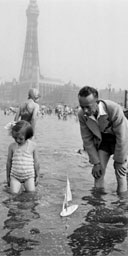
The couple have been fast asleep, unidentified and untroubled, for more than 50 years in the archives of the National Monuments Record.
They were captured snoozing on the sands at Blackpool in the late 1940s, and now see the light of day in a book recalling the donkey rides and paddling pools, tea gardens and Punch and Judy shows - the lost glories of the English seaside holiday.
"People have been saying that the English seaside was dead for a long time now, but that's not true," one of the authors, Gary Winter, said. "It's true that not many people take their main holiday of the year there, but loads go for short breaks. Some resorts are still in very good heart."
He and his co-authors, Allan Brodie and Andrew Sargent, are working on a study of the history and state of the seaside resort for English Heritage and have produced their nostalgic picture book, Seaside Holidays in the Past, from the archives. They have walked that promenade, stayed in that B&B and eaten that ice cream in the cause of research, and they haven't finished yet.
"You might arrive in some places and think them a bit sad, but after walking around there's always something of interest, they each have their own story to tell," he said.
The railways made the resorts. Before that taking the sea air, and even more daringly sea bathing, were for the privileged few. The book records that in 1837 stagecoaches brought 50,000 visitors to Brighton, but in 1850 trains brought 73,000 - in one week.
The introduction of bank holidays in 1871, and paid holidays in the 1930s, meant millions had leisure for the first time. Employers sometimes helped: Bass brewers and Bournville chocolate were among the first to organise mass works outings. In 1919 the Lancashire and Cheshire Miners Federation took 100,000 people to Blackpool by 135 trains.
Many of the sites are now unrecognisable: Mazzoleni's cafe, looking like a Swiss chalet at the end of the pier in Herne Bay, advertising tea, coffee, chocolate and ices in an 1890s photograph, was burned down in 1928; and in Devon the towering Gothic Ilfracombe Hotel ended its days as council offices and was demolished in the 70s. The Warwick Tower at Great Yarmouth, with a revolving viewing cabin, lasted only until 1939.
The photos show most beach-goers in heavy dark clothes until well into the 20th century, and in one Edwardian picture boys are paddling in three-piece suits, collars and ties. Even in 1946, when a photographer captured a young woman on Blackpool beach in what looks like a homemade knitted bikini, most of those around her are clothed from head to foot.
