
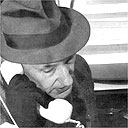
In 1966, at the London Roundhouse launch of International Times, films by Kenneth Anger and the writer William Burroughs were shown while guests, including Italian director Michelangelo Antonioni, Yoko Ono, Marianne Faithfull and Paul McCartney, tripped out to the music of the Soft Machine and Pink Floyd. In the West End, at the nerve centre of the 1960s underground, the notorious bookshop Better Books in Charing Cross Road, concrete poet Bob Cobbing began film screenings as part of a series of events and "happenings".
The arrival of film-maker Steve Dwoskin from New York fuelled the desire not only to show films but to make them. In October 1966, as John "Hoppy" Hopkins and Barry Miles were launching International Times, a telegraph was sent to Jonas Mekas at the New York Film-makers' Co-op announcing the birth of its London counterpart and promising to: "Shoot shoot shoot." It added: "No bread no place to lay our heads no matter."
The Co-op has been one of the great unrecognised success stories of British film culture. In its three-decade run, it served as the home of underground-cum-avant-garde-cum-artists' film (the nomenclature shifts all the time). For those 30 years, it sustained production through its workshop, exhibition through its cinema, and visibility through its distribution arm. The result was personal film-making at odds with the mainstream.
The idea that film was intrinsically a visual medium and not just for telling stories was at the core of the Co-op's operation. It was also unique in its production capacity. You could walk through its doors and shoot a film, process it, print it, optically print special effects and show it without leaving the building. Even the New York Co-op, the model for all the co-ops in the 1960s, did not have this capability.
In the years following its birth, the venue for screenings of mainly European art movies and US underground films of the sex-drugs-and-rock'n'roll kind and was transformed by a group of artists into a production unit of full-blooded British avant-garde which was to express a hard-edged rawness and ruthless experimentalism, contemporaneous with similar work in Germany, Austria, Poland, Japan and Holland.
In its first few years the Co-op fell under the umbrella of the London Arts Lab and was joined by young activist artists with a more fine-art agenda, crucially Malcolm Le Grice, Peter Gidal (in 1968) and David Curtis. By 1969, it took its first steps towards independence, settling down eventually in Prince of Wales Crescent in London's Camden Town. The working conditions were basic, money non-existent and equipment often hand-made. Le Grice made a film processor out of Hoover parts, rubber bands, whatever lay to hand.
But films proliferated, unaided by grants until around 1976. The Co-op took the notion of an arts laboratory to its logical end, by exploring all the mechanical devices (time lapse, overprinting, colour filters, focus manipulation and conceptual conundrums) of the film as a machine for presenting the world. It also developed multi-screen, performance-based work, and what is now called installation.
The result was an intensely visual, meditative cinema, which in its distaste for the melodramatic and high-falutin' often took as its subject the streets of east London, the outlook through a window of a west London basement, and the harsh Welsh mountains.
By the late 1970s, most of the original group had left, handing over the organisation to a younger generation of artists. By then, the punk reaction to all things 1960s had marginalised the Co-op further.
But if its cinema sometimes had a problem getting an audience, the stream of young film-makers looking for cheap access and help with equipment never ceased. Similarly, its distribution wing was sitting on one of the finest avant-garde film archives in the world, including almost complete collections of work by Stan Brakhage, Michael Snow, Bruce Conner, and Robert Breer. There was always a demand for these classics.
But closer to the Co-op's 1960s principles was its open-door policy to film. It welcomed "all non-commercial film submitted for distribution". Student films sat alongside major artists' work. Even pornographers arrived with their offerings; to its credit, the Co-op didn't automatically turn them away.
Equally democratically, staff were re-elected every couple of years, and all members had a vote. Orthodoxies or fiefdoms were never allowed to establish themselves. Its Saturday morning AGMs, where new staff were voted in, were infamous for their often horrific blood-lettings. The past was ruthlessly exorcised and the new gang installed - until the next time, when the same procedural theatre was repeated.
As the rest of the art world bowed to bums-on-seat Thatcherism, the Co-op carried on its Hobbesian democracy. It was an institution for the young, with all the headstrong energy and often adolescent charm and naivete that suggests. But equally it could also be dogmatic, neurotic and sullen and unfriendly to outsiders.
In the early 1980s, I witnessed the Co-op run by hard-line feminists (on occasions literally storming the projection booth and tearing an offending film out); the New Romantics (Cerith Wyn Evans in a kilt and bovver boots filming a young man in his underpants hanging from the ceiling); an early and faintly paranoid showing of Black Audio Film Collective's slide-tape Signs of Empire.
It provided shelter for umpteen film-makers at some stage in their careers, many more famous as art-film directors or gallery artists - Derek Jarman, John Maybury, Sally Potter, Patrick Keiller, Cerith Wyn Evans. But it was also wonderfully unappreciative of its main funders, the British Film Institute (who supported it as a workshop) and the Arts Council. Biting the hand that fed it led to a long battle. It eventually agreed to merge with the more authoritarian London Electronic Arts to form the Lux complex in 1996. Horrifically, by 2001, it had collapsed as rents forced it into liquidation.
What had been born in poverty, survived on a pittance for 30 years, ironically (or typically) gave up the ghost in a fiasco of big money and exploitative contracts. Yet the Co-op's spirit is alive and well wherever its artists and audience can blag a room. Nowhere is too run-down, or too grand: the Royal College of Art, the Photographers Gallery, Tate Modern.
Whether it rises from the ashes remains to be seen, but in the meantime its legacy of films and sheer tenacity can hardly be questioned.
· Shoot Shoot Shoot runs until May 28 at Tate Modern, London SE1 (020-7887 8008), then tours internationally until 2004.
