
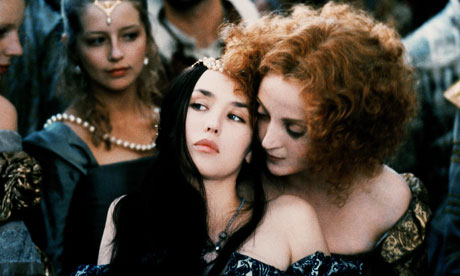
Director: Patrice Chéreau
Entertainment grade: B+
History grade: D
Marguerite of Valois, known within her family as Margot, was queen of Navarre from 1572 and of France from 1589. She was famed as a poet, a leader of fashion and a political operator. After her death in 1615, she achieved further fame when her juicy memoirs were published.
Marriage
The film begins with the Catholic Margot (Isabelle Adjani) reluctantly marrying the Huguenot King Henri of Navarre (who should be 19, but is played by the 44-year-old Daniel Auteuil). In the film, as in real life, this causes trouble. The inter-faith match has been fixed by Margot's mother Catherine de'Medici (played brilliantly by Virna Lisi as the wicked queen from Snow White), who has thoughtfully murdered Henri's mother as a wedding gift. Historians generally regard the story that Catherine sent Jeanne of Navarre a pair of poisoned gloves as fiction.
Sex
According to this movie, any two people who weren't killing each other at the French court were probably shagging. Margot is shagging the Duke of Guise. Her new husband, Henri of Navarre, is shagging Charlotte de Sauve. It is heavily implied that Margot and her royal brothers have all been shagging each other. Margot's second surviving brother, the Duke of Anjou, is not only the favourite child of Catherine de'Medici, but is possibly shagging her too. Most of this is malicious rumour, stoked enthusiastically by novelist Alexandre Dumas. Dumas wrote the novel on which this movie is based almost three centuries after the actual events therein. If you like breathless sixteenth-century gossip, the more common story about the Duke of Anjou (later Henri III of France) was that he was gay.
More sex
Almost the only people who aren't shagging or killing each other are Margot and her husband. Margot meant to spend her wedding night with the Duke of Guise, but he's sulking because she married someone else. She roams the streets looking for a replacement. Fortuitously, the streets are full of hunky Protestants lounging around in billowing linen shirts and leather bloomers, all looking pretty much up for it despite their presumably puritanical leanings. Margot picks the hunkiest, Joseph de la Môle (Vincent Pérez). La Môle was a real person, and is often listed among Marguerite's reputed lovers (though no historian claims they met under these circumstances). That's about as far as the reality goes.
Violence
Just six days after Margot and Henri marry, the St Bartholomew's Day Massacre is unleashed on the Huguenots in Paris. During the fighting, La Môle is multiply wounded by marauding Catholics. He staggers into Margot's bedroom and collapses. This is based approximately on a real story: the morning after the massacre, a gentleman wounded by sword and pike was chased into Marguerite's chamber by four archers. "I screamed aloud, and he cried out likewise," she admitted in her memoirs, "for our fright was mutual." When they both calmed down, she saved his life. But she named the man as Monsieur de Teian – not La Môle.
Death
Plotting to poison Henri of Navarre, Catherine de'Medici infuses a book with arsenic and leaves it for him. Instead, her own son Charles IX picks it up. The king endures a slow and disgusting death, convulsing and literally sweating blood. Both he and Margot wear white for the duration of his torment, apparently with the sole purpose of providing a graphic image for the film poster when he bleeds copiously all over them both. By contrast, the American poster instead featured Margot and La Môle looking all lovey-dovey, wrapped in a comfy blanket. Pity anyone who turned up to La Reine Margot expecting heartwarming romance and instead got two hours of stabbing, shooting, goring, poisoning, incest, beheading and defenestration, ending with the king of France turning into a human blood fountain. The real Charles IX did indeed die horribly at the age of 23, but the cause was probably tuberculosis.
Verdict
La Reine Margot is a spirited adaptation of Alexandre Dumas's novel. Both novel and movie, though, are rambunctiously fictional versions of history.
