
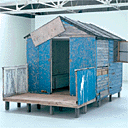
Anyone who was shocked by Tracey Emin's Bed should see the state of the artist's shed. Emin's latest installation is a bombed-out beach hut whose peeling decrepitude and accompanying photographs of the artist cowering naked in a corner suggest the scene of a sexual assault.
Only Emin would parade her demons so publicly, but the salt-weathered shack forms a striking centrepiece for a show about the sea, appropriately mounted in a gallery surrounded by water.
For Romantic artists, the sea was a symbol of the perilous sublime. For 17th-century Dutch painters, it was a glassy suface on which to show off their fleet. But as there's no longer a market for portraits of admirals, what passes for modern maritime art?
The answers are inevitably rather fluid - instead of a clear consensus, we are presented with a moderately diverting collection of clever, aquatic conundrums. Chris Welsby's row of shoreline-level monitors, for instance, projects a video of the tide washing in to remind us that, even with the real thing lapping up outside, we're generally more comfortable watching the highlights on television.
Similarly, Dorothy Cross's tricksy superimposition of broiling waves in a porcelain vessel is really no more than a storm in a teacup. Richard Long's concentric rings of white stones suggests a neat reversal of a physical process. It's what would happen if you threw a ripple into a pond and made the pebbles spread outwards.
Vija Celmins's images seem to have great clarity until you realise, with some astonishment, that they are actually wood engravings in which every undulation of the ocean's surface has been traced with Durer-like dexterity. Compare this with Felix Gonzalez-Torres's metaphor for oceanic depth: a stack of photocopied wave studies arranged like a tear-off desk calendar, typical of his ultra-disposable, endlessly replaceable art.
More fun is to be had with James Peel's documentation of 19th-century shipwrecks, with their morse code distress signals transcribed as piano-roll music. But as such wildly disparate contributions suggest, the sea is too vast a subject to be summarised successfully. The work on display here is no more than a drop in the ocean.
Until September 23. Details: 0151 702 7400.
