
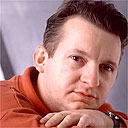
Two substantial works by Mark-Anthony Turnage, which premiered in Switzerland and Holland last year, arrived in Britain on successive days, courtesy of the London Sinfonietta and the Birmingham Contemporary Music Group respectively. Oliver Knussen conducted the Sinfonietta in the first performance of Dark Crossing in Basle in November, and did so again in London.
A 20-minute, three-movement work hinting at some kind of programmatic basis, Dark Crossing is a beautifully judged orchestral set. The brooding first movement springs from some scarcely veiled allusions to Debussy's La Mer; the bracing second sets athletic wind figures against long, steadily unfolding lines. The finale is a song-without-words, requisitioned from a projected song-cycle and full of exquisite tracery and haunting melodies.
Dark Crossing was the centrepiece of a programme made up of UK premieres. It was preceded by Hans Werner Henze's 1997 Trauer-Ode für Margaret Geddes, a perfectly shaped, aching elegy for six cellos woven around a Bach chorale. And it was followed by the Dutch composer Robert Zuidam's hour-long McGonagall-Lieder, a ridiculously prolix homage to the Scottish poet that embeds histrionic settings of his two Tay Bridge poems (expertly sung by Lucy Shelton) in a framework provided by two pianos and strings.
The concert was a typical Sinfonietta occasion, dashingly performed, and deserved a far bigger audience. Unforgivably, it clashed with the BBC Symphony Orchestra's Feldman portrait at the Barbican: new music in London simply can't afford to shoot itself in the foot like that.
There were no audience problems for the BCMG on Saturday: Birmingham's CBSO Centre was packed for the start of what the ensemble is calling its Bass Inventions tour. That is the title of the work Turnage composed for the jazz bassist Dave Holland, who introduced it with the Asko Ensemble in the Amsterdam Concertgebouw last May, and repeated his remarkably persuasive performance here.
Turnage has provided Holland with a showcase, part notated, part improvised, and used his wonderfully warm tone and understated expressiveness to set the mood of the work. The ensemble writing folds around the mostly pizzicato bass lines rather than contrasts with them, and the musical material is almost deliberately unabrasive. It is one of Turnage's most subdued and reflective works.
Subdued and reflective aren't words to describe Gerald Barry's Dead March, the latest BCMG commission. A bundle of rawly scored rhythmic unisons, isolated gestures and stuttering repetitions riven with silences, it inhabits a world of potentially ferocious extremes. It will seem even more disconcerting when the BCMG and the conductor Peter Rundel get right under the music's skin.
· The BCMG are at the Anvil, Basingstoke (01256 844244), tomorrow, then tour to Cambridge and Brighton.
