
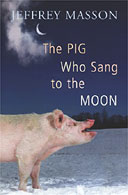
The Pig Who Sang to the Moon by Jeffrey Masson
Many years ago, Jeffrey Masson was a precocious controversialist whose Freud: The Assault on Truth placed him at the centre of a mini-cyclone of self-publicity, a place he has occupied, on and off, ever since.
Masson is a man of extremes. Having infuriated the American psychoanalytic community, he became mired in a bruising lawsuit against journalist Janet Malcolm and the New Yorker over a disputed magazine profile. The experience of the California legal system (the case was heard in San Francisco) appears to have soured him on the human race. For the past decade, he has devoted his energies to writing about animals and their rights in bestselling books with titles such as When Elephants Weep and Dogs Never Lie About Love. He also lives in New Zealand, where the sheep outnumber the population by 10 to 1. It was near Auckland that he met the pig whose lunar warblings inspired this book.
This is not just a hymn to the Berkshire, the Tamworth and the Gloucester Old Spot, but to all manner of farm animals, from chickens to goats. Masson argues that animals who express complex emotions like 'love, loyalty, friendship, grief and sorrow' deserve our respect and consideration. So if, like many people, you think that pigs are seen to best advantage on a plate next to an egg and a slice of fried bread, this book is not for you.
To Masson, eating animals is wrong, and raising pigs for food is a crime against the species. He calls his position 'a radical one'. It is also manipulative. You don't have to be Lord Emsworth to agree that pigs are special. Pigs, says Masson, have much in common with their oppressor, man. They dream and see colours. They enjoy family life and are fond of play. They know their own names. They are gregarious, omnivorous and individually fastidious. Some - how does he know this? - are prone to depression.
Not once does he concede the obvious point that these creatures don't have language, nor do they write books as misguided as this one. Animal rights are all very well. But the idea of life, liberty and the pursuit of happiness for our dumb friends is the kind of notion that could only make sense in a place like New Zealand - or California.
