
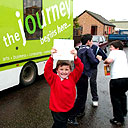
What do you do if children from particular backgrounds don't visit the library? The answer: take the library to them. It's a simple idea, and one that Essex county council and Essex Travellers Education Service (ETES) seized upon when they discovered that libraries were rarely used by the many traveller families that live in the county.
"We knew from our ethnic monitoring and other surveys that we needed to find ways to provide better access to travellers," says Nicola Baker, head of community and civic values at Essex county council.
"Then we hit upon the idea of mobile libraries. We already had a number visiting housing estates, villages and remote hamlets and thought they might be the answer.
"Given that travellers live in trailers, we thought they would be less intimidated by a library in a trailer than by an official building."
The hunch proved right. Since beginning visits to five traveller sites three years ago, the eight libraries involved have built up a loyal following of more than 150 children and their parents. Many more use the libraries that visit eight Essex primary schools chosen for their high proportion of traveller children.
"I have never encountered such an enthusiastic response," says Janet Carden, project co-ordinator of the Mobile Library Travellers Project. "I don't know of any other libraries where children are actually jumping up and down waiting for the doors to open. There's an enormous desire among mothers that their children should be good readers and progress well at school, and that's what we are helping them with."
So successful has the project been that last week it won the Libraries Change Lives Award for its innovative approach to promoting literacy and tackling social exclusion.
But its success was by no means a foregone conclusion. Staff were well aware that they might not be welcomed with open arms, and careful steps were taken to avoid alienating a close-knit community that is traditionally reticent about seeking outside help.
After the idea was first mooted in 2000, the ETES spent six months in discussion with site managers before the libraries made their first visits the following year.
"We were quite careful about how we approached the sites," says Kanta Wild-Smith, of the ETES. "We needed to prepare the ground, so people weren't intimidated. We went and spoke to people, knocked on doors and told them what to expect.
"We also had to train our librarians in cultural awareness. Many of them were very frightened of the idea. There is a huge amount of fear around the traveller community, which is entirely unjustified."
Each library - housed in a vehicle slightly smaller than a removal van - is staffed by two or three librarians and stocked with hundreds of books. Visits to sites are made weekly and last for around an hour; children can browse the shelves, listen to staff tell stories, and borrow books for up to three weeks.
Material includes the usual picture books, children's fiction and tapes and videos, but librarians have also been careful to carry books of particular relevance to the traveller lifestyle, including books on looking after animals.
"Most of the kids have animals of some kind - puppies, ponies, even ferrets," says Carden. "They will often bring their animals for us to see, and we try to give them books that relate to their own experiences."
Although literacy among the children is relatively good, among their parents it is a different matter.
"Knowing what material to provide for the adults is more complicated, because they can't always read," says Carden. "We offer traveller heritage and reminiscence books that are highly pictorial. It's a very close-knit community, and quite often older people will look through and recognise relatives from the past or places they know."
One of the most exciting outcomes of the project is its impact on parents who are illiterate. "We've had anecdotal evidence from schools that kids are borrowing the books and teaching their parents to read," says Baker.
The project recently obtained extra money from the Children's Fund, which will help with continued funding and expansion of the scheme. Plans are already under way to start visiting a further three sites by the end of the year.
"Being involved in a scheme like this gives you a really good feeling," says Baker. "Most of us spend a lot of our lives doing administrative work, which I suppose makes a difference in the end. But with this you can get out there and see it actually making a difference."
Carden agrees. "When I started this job, I was a bit diffident; I didn't want to be part of a project that changed traveller culture or told them how to behave," she says. "But this is the opposite. It's giving the children the opportunity to stay within the traveller culture, but to be literate. That's what has made the job such a joy."
· Essex county council is at www.Essex.gov.uk
