
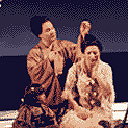
Puccini's Madama Butterfly is so familiar that most people overlook the inherent squalor of its subject and the contradictions it contains. The opera opens with an American naval officer buying a 15-year-old Japanese girl to be his sexual partner while he is on shore leave and ends with the same girl's suicide in the presence of their child, whom she has been forced to abandon to the officer and his wife.
The characters' motivations are ambivalently enunciated throughout. Pinkerton, the officer, claims he doesn't know whether "love or a whim" has drawn him to Butterfly. Her subsequent devotion to him is at once selfless, yet teetering on obsession. Were Pinkerton to abandon her, she tells her son, she would kill herself - though she omits all mention of the child's future after her death. The score is comparably ambiguous. Much of the opera has such sincere force that it's easy to forget that it opens with the rigidity of a fugue and ends with an ear splitting discord, its harmonic structure mirroring its dramatic irresolution.
Most directors shy away from its implications and drown it in sentiment, though David McVicar's production for Scottish Opera takes a fiercely dispassionate view. McVicar is strong on the conflicting cultural values between east and west that underpin the narrative. Ian Storey's Pinkerton is an exploitative capitalist who believes he can buy anything - including his way out of messy situations. Butterfly's family think nothing of selling her into what is effectively prostitution, though, hypocritically, they march out when they discover she has renounced her religion.
Butterfly's tragedy is that her depth of feeling is alien to both cultures. Astonishingly played by Natalia Dercho, she is a fragile creature who moves with controlled balletic grace, until emotions shake her body, which convulses first with desire, then with anguish.
The musical emphasis falls on vocal acting rather then expansive lyricism. Storey's voice does not flow easily in the love duet, though he adopts a tellingly ingratiating tone in Butterfly's presence that hints at deliberate seduction rather than genuine desire. Dercho occasionally sounds too mature, though her passionate declamation is second to none.
Derek Clark's conducting has an edgy intensity, though there are a few moments of ropy coordination between stage and pit. Some might find the whole a shade cool, but it does force you to rethink the opera from scratch and ensure you'll never take it for granted again.
· In rep until June 8, then touring to Edinburgh, Inverness and Aberdeen.
