
Like an erstwhile lord of the manor, Michael Winner is nowhere to be seen when we enter his house. There is, instead, a sense of his presence across all 48 rooms of the Holland Park mansion. An assistant leads us in, past the foot of a staircase above which hang two portraits of Winner, regarding each other from opposing walls to create a sort of Winner vortex effect. We descend to a basement screening room, decorated with memorabilia from Winner's 34 films, past a large airing cupboard in which two south-east Asian women can be glimpsed, folding linen. The assistant discreetly shuts the door on them.
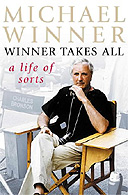
The night before, Winner, 68, attended the premiere of Andrew Lloyd Webber's new show, The Woman in White. It stars his old friend, Michael Crawford, whom he is concerned he may have upset by calling him a cheapskate in his new memoir, Winner Takes All. Winner's indiscretion is legendary, exceeded only by his reputation as a thrower of tantrums. I shall get to witness a mini eruption at the end of the interview, a rare sight, these days, since Winner now checks his temper for fear he is turning into his mother.
Last night, however, his overwhelming sentiment was one of shyness.
Shyness?
"Oh, I get immense bouts of shyness," he puffs. His eyes disappear beneath folds of mirth. "What are you talking about, dear? I hardly leave the house. I'm quite reclusive."
Winner likes to explain himself in terms of the zodiac: he is a Scorpio, which, he says, means, "We're very snappy and bad-tempered on the outside and very soft on the inside. Burt Lancaster was a typical Scorpio. He threatened to kill me from time to time, but a wonderful man. A wonderful man." One gets a sense of this contrast in the book; of explosions followed by equally extravagant apologies. Perhaps Winner is only rude to people for the thrill of saying sorry, for sending them champagne the following day. It's a largesse he takes to such lengths as tracing boys he stole pennies from at school and, 20 years after the event, sending them the money, plus interest. He is very alert to detail.
There is a sense, too, that the book was written with one eye, rather defensively, on his overblown image. "The only person I have to answer to for my behaviour, my attitudes and my activities is myself," he huffs at one stage. Winner says this isn't so - that he wasn't trying to correct a false impression. "Well, I can't deal with this so-called impression because I don't meet these people who apparently don't like me. If I walk down the street, people say, 'Calm down, dear', or they smile and say, 'Love Lawman, love Death Wish'."
I wonder if it irks him that a whole generation only knows him for the phenomenally successful Esure adverts - which were his idea - rather than for his films? "Well, I mean, there's no question that that catchphrase became so popular. But the films still turn up on television all the time. These films are not on at three in the morning; they're on at peak hours, CONTINUALLY. Probably 10 or 12 a year. And then they have the displeasure of seeing me on various television programmes, Reeves and Mortimer or something like that. The youth television people always seem to like me."
Winner's film career took the very unEnglish path of great and early success in Hollywood, although it's been a while since he has made anything memorable. He is continually amazed by his own bad judgment: he turned down James Bond, The French Connection, The Prime of Miss Jean Brodie and the remake of King Kong. "I don't know why I turned down James Bond. I can't imagine. I took the call right there, 1971. 'Are you interested in James Bond?' they said. 'Harry Saltzman would like you to do it.' I said, 'No.' I mean, it's not as if I was making Hamlet! Oh, no thanks, I only do Ibsen! I was only doing thrillers anyway. A moment of lunacy."
But he shrugged it off? "You have to. Otherwise it would put you in the asylum."
In the long run, Winner believes it is better to be "relentless" than "smart". He got his first job in directing after sending hundreds of letters out to production companies. He blagged himself a showbiz column in the local newspaper while he was still at school. At Cambridge, he was the most famous man in his year, primarily for his talent for self-promotion. He also worked very hard. "Extraordinary. Just total, total desire that consumed me, to the exclusion of all else, normal relationships, family, any normality was thrust aside. Really until about six or seven years ago." He laughs, like Basil Brush.
If there is one thing he regrets, it's not having given more time to his parents. The house in Holland Park is the one he grew up in - he converted it from flats owned by his property developer father. Winner made a separate fortune from his own canny investment in property. He seems to need a great deal of space around him and wishes the house was even bigger. But Michael, you can only be in one room at a time.
"Well, but that doesn't matter, you can walk around them!"
I mention that I saw a couple of people in a large cupboard as we came in.
"Well," he says, "that's quite likely. There's quite a large staff."
Winner's mother was a compulsive gambler. She lost roughly £8m in the casinos of Cannes. He thinks of her when he's being unpleasant; "She could be very caustic," he says. "She was always attacking my father, which was dreadful. He never attacked her. She was always putting him down. But you know George Bernard Shaw said: It's better for a parent to be a horrible warning than a good example. Wonderful phrase."
I have a story about Winner's snappishness from a friend of mine's mother. I ask, tentatively, if he recalls being in a restaurant in Covent Garden, I'm not sure how long ago ...
"Must've been a bloody long time ago, I can't remember ever being in a restaurant in Covent Garden."
As I heard it, he was asked which table he wanted and pointed to one that was already occupied. Then he asked for the people to be turfed off.
"Absolute rubbish. I want to tell you, dear, there are more nonsensical stories about me than anybody. First of all, I don't ever remember going to a restaurant in Covent Garden. And why should I have been there with your friend's mother ..."
I tell him who it was.
"Oh," he says. "That I remember. Very well indeed. Yes, yes. I will almost withdraw, but not totally." He explains what a terrible table they were given, next to "17 men in suits who were already on their way to being drunk. So I was certainly not prepared to spend the next two hours of my life at that table. I went upstairs and I said, why can't we sit there? Why didn't you book that table? And the man said, 'Well, it's reserved.' I said, 'Well, can't you move the people somewhere else?' They weren't sitting there yet." The manager refused. "So I walked out."
The next day he sent a bottle of champagne with an apology. Until recently, when Winner answered the phone it wasn't uncommon for the person on the other end to ask if he had been running. Now he does half an hour of Pilates every morning and takes afternoon walks. This is at the behest of his girlfriend - his "current girlfriend", he says, wickedly - without whom he believes he would be dead. Georgina, is it?
"Geraldine. Georgina was the previous one. Rather similar name; I sometimes call her Georgina. That gets me in serious trouble."
Geraldine is only the second of Winner's girlfriend's to have moved in with him, although she tends to occupy "her own little room" at night. Jenny Seagrove was the other. "When we got together with Seagrove," he says at one point, regally. Winner's relationships have tended to end, he says, because the girlfriend in question always wanted to get married, and he never did. But he's had some long relationships. "I was about 10 years with an actress called Jill Gascoigne. Not the famous one, another one. I was six and a half years with Seagrove! That's not a short time, is it? Not many marriages last that long these days."
Loyalty is very important to him. He is generous with money and with friendship - he is on terms with almost all of his exes. In fact, Seagrove is one of the few ex-girlfriends he is not on good terms with.
"I'm on terms, she won't talk to me!" he splutters. "I wrote her a letter. I said, 'We really should meet some time for a chat. And she wrote back, three years after she left me, and said, 'I'm not ready for a chat yet!'" He explodes, "Well, how long do you need to get ready for a chat, for goodness sake! I wasn't asking for a blow job; I was asking for a chat! Unbelievable! Ha ha."
The love of his life - "In a way, yes" - was the actress Jill Ireland, who later married Charles Bronson. "She was just such a marvellous person. I mean, the relationship didn't last that long. It probably only lasted about four months. Cos she then said, 'I'm 21, I want to get married, will you marry me?' and I said, 'No, I'm 22, I can't get married'. But we stayed friends until she died."
Does he ever wonder what would have happened if they had married?
"Well, she was very flighty on her first marriage, there's no question. And so she would've been flighty with me, I'm sure. Very flighty, bless her."
He thinks that he would have made a good dad, "because I'm utterly childish and silly. I can be unbelievably silly. I think I'd have been good. But it obviously doesn't concern me. It's a bit late now."
The aim of life, believes Winner, is to avoid boredom. This is why so much of the British film industry depresses him. "Until very recently we had no producers who thought commercially at all. They all wanted to impart a message. You know, the sort of David Puttnam school, 'We must say something meaningful.'" He looks disdainful. "Well, bollocks to that. The film audience wants an hour and a half of light relief in a dark room after a heavy day. Michael Caine said to me the other day, 'I don't want to go to the theatre unless there's tap dancing.' I thought it was an extremely intelligent remark."
All this while, unbeknown to us, Winner's assistant has been hovering on the other side of the door, prevaricating over whether to come in or not. She does, eventually, to tell Winner that someone came to the door for a parcel, which she couldn't find; rather than disturb him, she let the courier leave empty-handed. Winner clucks with exasperation. "Ach!" he says. She has done the wrong thing.
"What would you like for lunch?" she asks, meekly.
"I AM TALKING!" screams Winner. At last; a flash of the old stuff. His assistant backs out of the room.
I ask Winner if he enjoys his own company.
"Oh, wonderful," he says with a twinkle. "I love me."
· Winner Takes All by Michael Winner is published by Robson Books.
