
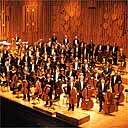
André Previn must be about as famous in Britain as any conductor today can be. For millions of us he will always be Andrew Preview, and he's the only living conductor I can think of who has found his way into the lyrics of a pop song (The Beloved's Hello is, admittedly, unlikely to prove immortal). He and the LSO are old friends, though the personnel will have changed rather since he left his post as its principal conductor 23 years ago. This much presumably explains the decision to programme two identical concerts with him on consecutive evenings. However, for letting him replace Korngold's Violin Concerto - 25 perfectly decent minutes of enjoyable slush - with his own 45 minute essay in the genre there can be no excuse.
The piece was written last year for the violinist Anne-Sophie Mutter and premiered in Boston in March. She plays it very competently, letting us hear all the hows of the music but without conveying the answers to any of the whys. For example, why the moodswings from queasy sentimentality to spikiness and back again? Why do climaxes emerge from nowhere, without having to be sought and struggled for? Why are promises of conflict and argument not worked through to a resolution? And, most urgently, where is Previn's own voice in all of this?
Of the three movements, the finale works best, but mainly because the variation form in which it is written allows for colourful, episodic writing rather than taut musical argument. There are some striking and beautiful episodes, it is true, but Previn's tricks have all been pulled before. Overall, the impression is of a piece that dips liberally into the sound worlds of Strauss, Prokofiev and, especially, Britten, and then pulls back just in time to stop the publishers calling their lawyers.
After the interval, there was some real romantic sweep and ardour with Rachmaninov's lush Second Symphony. Previn drew a strong, vibrant sound from the strings and, after a slightly genteel allegro molto, the adagio had some bright wind solos cutting through a fluid string accompaniment. But still, there were too many smudged corners and moments of loose ensemble.
If Previn wants to know how to write gloriously sentimental music he could have no better teacher than Rachmaninov; indeed, episodes of the Second Symphony are as soppy as music should ever be allowed to get. I never thought I would hear anything to make them sound astringent by comparison. Until last night.
· Further performance tonight. Box office: 020-7638 8891.
