
Theatre, Michael Billington
Two big questions confront the theatre following the traumatic events of September 11. Given that American visitors normally make up a third of its audience, how should the West End deal with the inevitable shortfall? And how should theatre in general react to what could be a continuing crisis? Should it offer an instant escape or try to match the gravity of the situation?
It is difficult to discuss box-office percentages without sounding ridiculously trivial. As Christopher Hampton points out in Tales from Hollywood, the reaction of film industry magazine Variety to Hitler's march into Czechoslovakia was to note that: "It represents a loss of two-and-a-half to three per cent of total foreign film income." None the less, even before September 11, alarmist reporting of the foot and mouth crisis and BSE was deterring American visitors. So the theatre this summer was already in trouble. But in the words of Rupert Rhymes, chief executive of the Society of London Theatre, "What was a bad year is clearly going to get worse."
How much worse, no one yet knows. Rhymes told me that there was plenty of anecdotal evidence, ranging from eerily deserted foyers to news that even hit shows such as The Lion King had suffered cancellations from American visitors.
But the wider question is whether the whole content of British theatre will be affected by the crisis. Do people want escape or uplift? My guess is that audiences, as ever, want both. It's not an exact parallel, but in the early months of the second world war, after an initial period of closure, the theatre sprang to life, and among the expected musicals and revues you could find Shakespeare, Shaw, Strindberg, Synge, O'Casey, Priestley, American Elmer Rice and even, somewhat surprisingly, a traditional Chinese play.
What can we learn from that? Simply that while escape is perfectly legitimate, there is still a large section of the audience that craves great drama to meet a global crisis. It went even further in the second world war in that leading actors such as Sybil Thorndike and Lewis Casson took the classics out to local communities and thereby tapped a whole new audience.
Circumstances today are radically different. But I would argue that theatre's best chance of survival in a time of crisis is to hold its nerve, refuse to dumb down and, as always, offer audiences nothing but the best.
Dance, Judith Mackrell
For dance, the most immediate and obvious fall-out from September 11 was the cancellation of the high-profile season given by the Alvin Ailey American Dance Theater at Sadler's Wells. The New York-based troupe had been due to start performing in London less than a week after the attack. Yet even though the uncertain flight situation had resolved itself in time for the company to travel to London, the traumatised dancers felt unequal to the strain of either flying or performing so soon after the event.
Suddenly Sadler's Wells was left with an empty week and the possibility of having to refund over 10,000 tickets. Fortunately, the majority of ticket-holders have been willing to transfer to replacement dates, but this won't make up all the financial losses: it would take only a couple more cancellations to seriously rock the venue's budget.
For dance in general, cancellation and disruption to programming is likely to be the biggest problem. The international dance community is small and unusually nomadic, and just as companies look to foreign tours to bolster their audiences and their revenue, so theatres look to foreign artists to bulk out their programmes. Companies such as Mark Morris and Merce Cunningham are possibly as well known here as they are in their native America. And Morris happens to be one of the many foreign names scheduled to appear in this autumn's Dance Umbrella. Since visitors outnumber home performers in Umbrella, the programme would be drastically reduced if the former started to cancel.
The impact on audience numbers should be less extreme. Although tourists are key to the planning of London's blockbusting summer ballet seasons and the Edinburgh festival, the core dance audience tends to be more local and loyal.
And what the public sees on stage is unlikely to change dramatically either. As an art form, dance is ill-equipped to deal with either the specifics of politics or the scale of the disaster. Those choreographers whose work crosses over with theatre will have a more explicit language with which to raise issues of war and ideological conflict.
Among those whose medium is pure dance, however, the shocks of the new global agenda may make their impact more insidiously - in a darkening of tone and atmosphere, perhaps. Or worse, in a disinclination to create altogether.
Classical, Andrew Clements
On September 11 American composer John Adams happened to be in London, conducting the soundtrack for a TV version of his second opera, The Death of Klinghoffer. The subject matter of Klinghoffer is terrorism; it portrays the events surrounding the Palestinian hijacking of the cruise liner Achille Lauro in the Mediterranean in 1985, which led to the murder of one of its passengers, wheelchair-using Jewish American Leon Klinghoffer. The score has been dogged by controversy since its first performance in Brussels in 1991, heavily criticised (and even picketed at its US premiere) for its studied neutrality.
Subsequent productions have been scarce, and in the wake of the terrorism in New York and Washington, it's hard to imagine that any opera company will contemplate a new staging. Opera rarely finds itself in such a delicate - one could say relevant - position, for Adams is a rarity among present-day composers in tackling modern real-life subject matter. His first stage work, Nixon in China, dealt with the meeting between Richard Nixon and Mao Zedong in Beijing in 1972, while his third, I Was Looking at the Ceiling and Then I Saw the Sky, explored the consequences of the 1994 Los Angeles earthquake.
Among his great predecessors, perhaps only Verdi dealt with historical subjects with the realism and pertinence that Adams is trying to bring to the genre. As far as opera is concerned, the two world conflagrations of the 20th century have hardly been tackled, and it seems highly unlikely that any present-day composer will consider building an opera around the recent atrocities.
But if opera, by its intrinsic, highly artificial nature, puts a frame around reality and tends to distance itself, then concert music, by its very abstraction, can suggest emotional responses in either a direct or a highly ambiguous way. Works may unwittingly take on an elegiac function: the potency of Barber's Adagio for Strings, played as a memorial to those who died in the US at the Last Night of the Proms, is a perfect example. Or they may be loaded with a specific relevance, as in works as diverse as Benjamin Britten's War Requiem, John Corigliano's First Symphony (his memorial to the victims of Aids), and Michael Berkeley's and Ian McEwan's protest against the dangers of nuclear war, Or Shall We Die? The idea that composers may write orchestral or choral memorials to those who died in the twin towers is much more plausible than the notion that they will produce operas.
New opera productions progress particularly slowly; plans are laid and contracts signed years ahead. It would be difficult to carry out short-term economies in anything but the most crude and draconian way. In any case, what would they do - fall back on the most popular works at the expense of the less familiar, in the hope that audiences would come flocking back, or hire less expensive home-based performers rather than glitzy international stars? Both strategies, for the moment at least, seem unlikely.
Art, Adrian Searle
An immediate impact on visual arts of the twin towers outrage and subsequent events has been the effect on international travel. This doesn't just mean that artists, collectors, curators and dealers will zoom about a bit less on the international circuit - works travel too. Some loans for Tate Modern's current Surrealism show were held up in transit, and an exhibition by Canadian film-maker and artist Michael Snow at Bristol's Arnolfini had to be delayed. How trivial, you say - and in a way you'd be right.
But what kind of art can we expect as a response to September 11 and its aftermath? It is too early, vulgar even, to be thinking of memorials and potent symbols. I guess that a lot of art is already being made that deals not with the events themselves, but the media reaction to it. Expect recontextualised video clips (the guy recoiling at his sidewalk table, as he glances up at the big boom), more or less convoluted deconstructions of Fox News and CNN, Warholian portraits of Bin Laden and screeded off-prints of the world's headlines and press photos. Expect disaster movie art, art about race and religion. Expect dumb curatorial ventures into the sacred and inter-cultural conflict, Islam and abstraction, protest and jihad. Expect wince-making metaphor.
Very little significant art has been made in response to war in the age of mass media. The photograph, the novel and the movie said far more about Vietnam than any artefact stranded in the gallery. Jasper Johns's Flags, Frank Stella's pinstripe paintings and American pop art may have had an ironic, post-Korea take on America and its 1950s economic triumphalism and protectionism, but this subtext was missed by most - or studiously ignored.
Art's ability to make significant statements about global conflict, famine, ecological catastrophe, racism and the rest of the world's ills is severely limited. The big subjects are just too big, too unwieldy, and most art is too compromised by its own use-value as cultural commodity to function as meaningful social protest or propaganda.
What art can do, on the other hand, is show us something about where we are, what we share and what divides us, the cruelties that we commit. It does so not by competing with mass media, its spectacle and mendacities, but in more subtle ways, and rarely does it reach those who really ought to listen.
Expect art that struggles with its own impotence in the face of these events. What art might be better at is dealing with what comes later: the unforeseeable consequences on a human scale.
Pop, Alexis Petridis
The purpose of last Friday's American telethon, A Tribute to Heroes, was clearly charity rather than artistic innovation. Yet it was still telling that every artist present fell back on appropriate old material and fitting cover versions: Neil Young quavered through John Lennon's Imagine, Wyclef Jean performed Bob Marley's Redemption Song. No one attempted to address the terrorist attacks of September 11 directly in song. There were no stirring calls to arms or freshly written tributes to America's dead.
Over the past two years, rock music has polarised. At one extreme it has become inoffensive and eager to please. This was the music to which MTV turned in the wake of the atrocities: unobtrusive, adult-oriented hits from Travis and Coldplay. And at the other extreme, much recent rock music has been driven by rebellion and angst. As part of their newly adopted pseudo-revolutionary image, Primal Scream recently gave a live debut of a song called Bomb the Pentagon.
Such posturing is clearly untenable now. Political US rockers Rage Against the Machine have closed their website because of its anti-American sentiments. Rebellion, the lifeblood of rock music for over 40 years, is suddenly off the agenda.
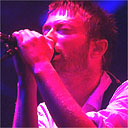
The death of Princess Diana proved that world events can affect rock music permanently. Even after the period of global mourning ended, the concept of swinging London and its carefree, cheery Britpop soundtrack never returned: it was replaced by the dark, brooding visions of Radiohead (pictured) and The Verve.
The immediate future clearly belongs to unobtrusive, adult-oriented rock and musical expressions of patriotism. But we can't just listen to Travis or Celine Dion singing God Bless America forever.
Amid the confusion, at least one artist has definitive ideas about the future. This week's NME features a lengthy interview with Noel and Liam Gallagher of Oasis, plugging their forthcoming 10th anniversary tour. While Noel makes a series of truly hilarious jokes about the terrorist attacks, Liam announces firmly: "I'm never going to America again, man. I'm staying put."
A small consolation for the shell-shocked US populace perhaps, but consolation none the less.
Film, Peter Bradshaw
It is a measure of the British film industry's irrelevance in the great American-dominated scheme of things that the terrorist outrage (which New Yorkers are calling "911" after the date of the attacks) has no obvious, immediate repercussions for us. The Hollywood studios are in shock; production has slowed down, apparently, almost to zero as the suits nervously second- and third-guess every potentially embarrassing or offensive movie or treatment.
Our British Lottery-funded movie world, with its regional locations and its twee post-Monty, post-East is East treatments, does not suffer any obvious hits. But is it perhaps niave to think that the vigorous support offered to President Bush by the British government will not drastically change the course of our film industry?
The Americans are clearly important as co-producers of our indigenous projects. Furthermore, they are big consumers of our production capacity: our studios, our sound stages, our technical expertise. A sluggish, nervy American sector is not particularly good for the British film industry.
And as for modifying our celluloid imaginations, well, I suspect that the first signs will come in television drama, which is far less reticent in translating the contemporary world into screen fiction. But there is, potentially, a further opening for commercial cinema at home and abroad. The US is backing away from the action genre, only now becoming aware that all those breathtaking scenes of danger are premised on a pre-911 faith that nothing bad like that could ever really happen on American soil. But the movie theatres are still open. The TV stations likewise. They need product, something has to fill the gap. And this is where our industry might come in.
Recently, Richard Curtis's romantic comedy Notting Hill did great business, as did Four Weddings and a Funeral. In the same vein, Sharon Maguire's Bridget Jones is triumphant all over the world. It might well be that gentle rom-com is just what the doctor ordered. FilmFour has a very solid new film on the stocks, Crush, starring Andie MacDowell. This could go down a treat with US audiences who don't care for explosions just at present.
And aside from rom-coms, British and semi-British movies such as Croupier and Memento have done tremendously well in the US. This is the sort of unusual, leftfield fare that American audiences might welcome as a break from the usual material.
