
The Whitechapel's show of new sculpture takes its title from one of Anthony Caro's best sculptures, from 1962, which currently stands in a display of New Generation 1960s British sculpture in Tate Britain. The equivalence between the welded, painted-steel, plastic and fibreglass sculpture of the 1960s and the young artists here is further underlined by the fact that New Generation was the name of a seminal 1965 Whitechapel show, and the current exhibition also talks about a new generation of British-based artists. But what does the radical abstract sculpture of the 1960s have to do with the five artists at the Whitechapel now?
Not much, even if one could talk about the truth-to-materials of welded steel and the literal truth of Shahin Afrassiabi's pots of household paint, his plastic drainpiping and wallpaper. Eva Rothschild's Bad Hat, a tall, black Perspex work, has certain affinities to the mad cone of an early Philip King piece at Tate Britain, but these formal similarities divert from the fact that Rothschild's work is less witty and funky than King's once was, and more timid.
Gary Webb has had one other critic weeping with joy. Webb's agglomerations of materials - granite, neon, Perspex, cast-glass hearts, fibreglass, rubberised floormats, cables and audio equipment are fun, but to my mind lost in their own hybridity. Looking at Webb's work I think rather more about other artists than about Webb's work itself. My eye takes Webb's pieces apart, but can't put them together again. A soft rendition of Somewhere Over the Rainbow wafts from a speaker in one work, but I can't find where Webb is going to, though he orchestrates the disparate elements very elegantly. Claire Barclay is potentially more interesting - there's an odd recall of 1965 Giacometti's famous Palace at 4am, let alone Caro's Early One Morning, in her timber, clay and cloth construction.
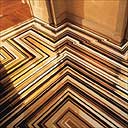
I'm surprised how meek and decorative much of this show looks. Jim Lambie, though, gets better and better. His optical floor here (the only other recent artist, aside from the late Juan Munoz, to push beyond Carl Andre's floor pieces) is really tremendous, especially with the pink belt from a 1950s dress inexplicably lifting up from the pattern in the middle of the floor. This is the most dramatic moment in the show.
"Less is more" used to be a modernist creed, and it works for post-postmodernists too. Lambie, unlike the others, is twisting the language of sculpture in an unexpected way. Standing in his space, you can feel his confidence and creativity. His work is surprising and unsettling.
· Until September 8. Details: 020-7522 7878.
