
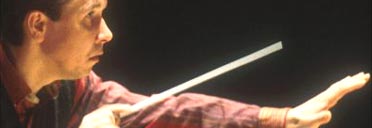
Eleventh-hour replacements don't come much more luxurious than hiring conductor Mikhail Pletnev to replace an indisposed Esa-Pekka Salonen. Pletnev ensured that the opening concert of the Philharmonia's new season had a suitably glamorous appeal, and his precision and passion in performances of Beethoven, Brahms and Sibelius made for an involving programme.
But there was a less happy change of soloist in Brahms's First Piano Concerto. The well-established Yefim Bronfman was replaced by Nikolai Lugansky, a Russian pianist at the beginning of his international career. In his late 20s, Lugansky has already appeared with major orchestras throughout Europe and the US. He plays with formidable accuracy and control, but seems detached and disembodied from the music - not qualities best suited to Brahms's most openly emotional work.
The First Piano Concerto, a response to Schumann's final years in a mental asylum, is young man's music. Its enormous first movement depicts intense grief and anger. The beatific calm of the second, written after Schumann died, commemorates both the elder composer and Brahms's growing feelings for his widow Clara. There is nothing restrained about this music: from the powerful surge of its opening D minor theme, it is uniquely raw and uncompromising.
But Lugansky gave us an old man's interpretation. His clarity and coolness were technically impressive, but his perfunctory, literal phrasing could not convey the grand sweep of the first movement. The subtleties of Pletnev's conducting were not reciprocated. The slow movement was reflective but never radiant, and it was only in the finale that Lugansky found a register of pianistic brilliance to match Brahms's virtuosic writing. He and Pletnev built the coda from extremely slow to violently fast music, at last capturing the excitement of the concerto.
Pletnev's interpretation of Sibelius's Second Symphony was more successfully balanced between restraint and emotional abandon, the whole piece moving inexorably towards its shattering climax.
