
Already some scores of thousands have been to Aztecs at the Royal Academy, and it is expected that by the end of the exhibition in April it will have been seen by more than half a million visitors. A popular success, then, but not, as one might have thought, an entirely predictable success: there was nervousness at the academy beforehand. The president himself admits to having been among the doubters, for the show was expensive to mount and at the time of its opening there was no guarantee that it would be taken on to any further venues. (It will probably now travel to Berlin and Bonn.)What makes a success of this kind? One always feels, when the Royal Academy pulls it off, that the galleries themselves have contributed significantly. That great suite of rooms is unlikely to flatter the weak, but it will certainly reward any collection of great works of art. It loves large paintings and it loves swagger: Van Dyck's portraits could hardly have looked better in their palaces. It loves large objects, and the organisers of the show have clearly been aware of this, and at pains to provide as many of them as could be found and transported.
The largeness of the works makes for easy viewing - one does not emerge cursing one's neighbour - while the horrific nature of many of them is enough to provoke a mass response. One feels like a visitor from the pioneering days of exhibitions, the early 19th century. We should all be wearing top hats and bonnets and shawls, and some of us should be reaching for our smelling-salts and coming over all queasy.
The catalogue has an illustration of one of those early exhibitions: it was held in the Egyptian Hall in Piccadilly - so, not far from the present academy - in 1824, and reflected an interest in the newly independent Mexico. A generation later, at the same venue, we find an exhibition called "The Aztecs!" which actually featured a couple of living examples. "These most marvellous of all Human Beings ever seen by White people were discovered in the hitherto unexplored City of IXAMAYA, in Central America, 1849. They are totally unlike anything deemed Human - their Heads being formed like the Head of an Eagle - Their Hair growing erect on the head, in form and dimensions of a huge grenadier's cap."
The text of the advertisement continues appreciatively: "Their frames are beautifully symmetrical, yet almost Lilliputian in size - eyes black and liquid - silky skin, of a deep olive colour - affectionate - amiable - intelligent - and pleasing in manner." They had been granted an audience with Queen Victoria, just before they went on exhibition. The Egyptian Hall specialised in this kind of freak show. It was where General Tom Thumb was exhibited by PT Barnum.
A recent reviewer, Dawn Ades in the TLS, takes the critics of the current Aztec show to task for lingering on the details of human sacrifice, and points out that the Aztecs "have often been made to carry within their own civilisation the seeds of their destruction." Inflated figures of sacrificial deaths, myths of cannibalism - are not these attempts to justify the conquest of Mexico, and the consequent obliteration of Aztec civilisation?
It is true that more than one visitor has emerged to declare (jocularly enough, but with a freedom one would not have when referring to most other peoples) that the obliteration of the Aztecs came not a moment too soon. And it is not entirely clear to me why Aztecs or Aztec religious practices should inspire such a particular horror in us.
It is not just a question of human sacrifice. After all, that is a theme from classical civilisation, and we have been accustomed to live with it. In an opera such as Idomeneo, human sacrifice is at the centre of the plot. It is seen, yes, as a cruel fate for the victim, but it does not have the particular sordid horror of Aztec sacrifice. Blood will flow if the vengeful Greek gods have their way, but we learn nothing of, for instance, those special receptacles for flayed skin, an example of which is making people gag at the Academy. The Aztecs tend to remind us of those multiple murderers who fail to dispose of the body parts, and who are eventually discovered amid scenes of dreadful squalor.
And then, as Ades points out, there is the point not lost on the Aztecs themselves, that human sacrifice was central to the Christian civilisation which was being imposed on them. Why are we not more horrified by Christian imagery, or why are we not just as horrified by the Christian iconography of the crucifixion as by Aztec art?
Well, perhaps we sometimes are. But familiarity does do something to blunt the horror. We certainly ought, when confronted by violent Christian imagery, to experience some deep horror, since at the very least that is what the images themselves are designed to inspire. We ought to feel that the saints really are being boiled alive, or shot to pieces, or flayed (like St Bartholomew).
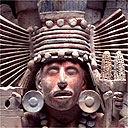
In gallery nine at the academy, there are two human-size terracotta figures, not surprisingly the stars of the show. One is an eagle man, supposedly representing the sun at dawn. The other is Mictlantecuhtli, the god of the dead, half stripped of his skin and with a large object - they say, his liver - hanging from his rib cage. These date from the late 15th century.
At that time, in Italy, terracotta figures were being made for churches in much the same way. Each of the Aztec figures was composed of four or five parts, just as the Italian ones would have been - the technology being perhaps the same, with kilns capable of taking objects of a similar maximum size. Then the parts would have been assembled and covered in stucco, and painted, as in Italy.
One ought to look at this eagle man and this half flayed god of the dead, with his liver, if it is a liver, opening like some great tropical fruit - one ought to look at them and think: the awe and unease I feel is no less than the European peasant was supposed to feel at the foot of the cross, or gazing up at some apse with a painted doom. This is nasty, yes, and this is scary, as well as being beautiful. But this is not entirely unfamiliar territory. Godhead, priesthood, sacrifice: I have heard of this, seen this, dreamt of this before.
