
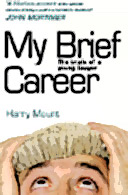
My Brief Career: The Trials of a Young Lawyer
by Harry Mount
Short Books £9.99, pp170
Edgar Allan Poe called sleep 'those little slices of death'; had he trained as a barrister, he might have altered this memorable epithet. Law, at least in the eyes of Harry Mount, is the tool that slowly chisels away at the edifice of life.
Mount got out before he expired at the Bar and yet his nightmarish year as a 'pupil' - a trainee barrister - still marked him deep enough to provide the material for his first book, a charming, lightly comic autobiographical reflection on a career choice gone horribly wrong.
Mount, now a journalist, was tempted into law during a spell of jury service. Tricked by the idealised, big-screen notion of the British justice system, he was ensnared, like many before him, by his own vanity.
'As a judge, or even a barrister, you might be responsible for changing the law of the UK by creating a legal precedent... throw in the intellectual content, the high-flown oratory, and then there's the money... you could rely on earning around £100,000 a year, more like a million if you were really good.'
The reality is altogether more grim. You can't blame him for failing to be inspired; life as a trainee barrister sounds horribly mundane, each day filled with monotonous, menial tasks and the study of some of the dullest textbooks ever put on to a printing press. Tedium and repetition typifies even the most desirable of jobs, but perhaps nowhere is the mundanity so evident as at the Inns of Court.
However, it's not solely the nature of the work that saps Mount's desire; it's the bloody awful barristers who do their most to turn trainees against their vocation. Mount does his pupillage with David Frobisher, a rude 60-year-old bachelor who 'hardly drank, didn't smoke, had few friends, no children, no girlfriend and minimal family contact. As a result, he had no natural demands of his time other than those made by his stomach and bowels'. It is not long before the monosyllabic mentor has ground down his initially cheery, committed understudy.
My Brief Career is being marketed rather clumsily - but also quite predictably, given the current obsession with pigeonholing all known art-forms - as a mixture of 'Dickensian tragedy and Bridget Jones's Diary'. These are misleading reference points: Mount is no Dickens but neither is he quite as whimsical as Fielding's ubiquitous antihero. Instead, My Brief Career (the queasy pun of the title aside) is more like a junior version of Lucky Jim.
Harry Mount's book is easy to enjoy - and should be recommended reading for anyone daft enough to consider a life at the Bar.
