
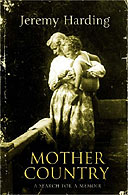
Mother Country
by Jeremy Harding
192pp, Faber, £15.99
If you're in the desert on a moonless night, searching for figures creeping towards you, you are more likely to spot them if you concentrate on the area where they are unlikely to be. Your brain is smarter than your eye and picks out the movements on the periphery of your vision.
I recalled this arcane piece of desert know-howwhile thinking about Jeremy Harding's quest to find his mother: the woman he calls "Mother One", who gave him up for adoption in 1952. He's been on the trail of this birth mother for the past decade, and the search, the documents, the emotions - all are meticulously noted down; but in the end, the real search in Mother Country seems subconsciously to be for the roots of identity in Mother Two - the woman who adopted him and brought him up.
The 20th century saw the rise and fall of an adoption system that affected the lives of large numbers of children, and which put great store on discretion, if not secrecy. Before 1926, adoptions were usually informal, often involving the extended family. However, when the government established official adoption practice in 1926 - after lengthy debates about confidentiality and access to birth certificates - it became the norm to blank out the past the moment a child was officially adopted. Papers were locked away, access was denied to those whose history they contained, and the prevailing view was that a new start had been made and should be maintained. The past 40 years have seen that view reversed; there is now an acceptance that help and guidance should be on offer to those looking for their roots.
Baby Jeremy arrived in west London when the old system was still in place. He was adopted at 11 days old. His search began 40 years later and, though his story is highly individual, it has elements in common with those of thousands of others who have taken advantage of changing attitudes.
It is here that Harding has the advantage of a very particular pair of parents who took him into their home: a stylish couple with a remarkable intake of scotch and gin and tonic and a penchant for damp, almost drowning, homes on the banks of the Thames. Maureen and Colin Harding emerge as determined players in the classconscious 50s: nicely-spoken, with enough money, a horror of trade unions and council-housing estates and a love of the exclusive golf club. Their adopted son, decades on, sees their faults but seems utterly entangled, even charmed, by Maureen's skittish ways, her elegant appearance, recalling how she would sing songs from popular musicals while slipping a little more gin in her tonic. It is her story that stands out during his search for his past. While hunting for clues to his natural mother's identity, he is drawn to looking at Maureen, eventually discovering an Eliza Doolittle story of a working-class girl married first to a very rich man, then to Colin, the man-about-town, stockbroker and professional bridge player.
The trail that eventually leads to his birth mother is scattered with a great many imagined scenarios, slightly repetitive and not entirely engaging. Perhaps this is inevitable - especially with sons looking for their mothers: daughters are perhaps a little more realistic about the circumstances in which women give up their children. However, there is perseverance and genuine sleuthing here, as Harding combs electoral rolls and snuffles out neighbours and distant relatives from the west London of 50 years ago.
The result - after a curious nearmiss with a delightful elderly gentleman whom he initially mistakes for his father - is a reunion with his mother and a cousin that is devoid of great tension or emotion. There is shyness, caution and a gradual opening up on all sides. But at this point there is also a realisation that we, as readers, know almost nothing of his birth family. They have hardly been mentioned, as the book roams around the social snobberies of the 50s. Harding's driving motive isn't so much a need to belong, common among some adoptive children, as a desire to put the past in order, to shuffle the shadowy figures who gave him life with the curious figures who cared for him.
In the end, it's a personal tale of identification and resolution, carefully written, but with the author an oblique presence - still, in effect, a small boy, tantalised by stray remarks about his origins. And having stared hard into the void of his past to find his biological mother, the character that emerges as the most fascinating presence is not that mother at all, but Maureen, glass in hand, warbling enchantingly to the little boy she brought up.
· Kate Adie's Nobody's Child is published by Hodder
