
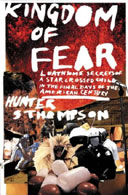
Kingdom of Fear
by Hunter S Thompson
Allen Lane £16.99, pp384
The subtitle of Kingdom of Fear, Hunter S Thompson's latest instalment of gonzo memoir, is 'Loathsome Secrets of a Star-Crossed Child in the Final Days of the American Century'. Is there a distant echo somewhere in there among all those words? Fear, loathsome - Whack! Dong! - ah, yes, they do ring a bell.
In fact this is the third book since Thompson's 1971 masterpiece Fear and Loathing in Las Vegas to contain titular variations on fear and loathing - and that's not counting the umpteen magazine pieces that bear their standard. Such is the regularity with which they crop up in the Thompson oeuvre that one almost expects them to be appended with a registered trademark symbol. Inevitably their presence invites comparison with the original and, as yet, the comparison has not been flattering.
Adjectives that might also fall under the Thompson patent would include savage, lurid, wild, weird, crazy, evil, brutal, depraved and foul. But what started out as an intoxicating and intoxicated style has become over the long years an exhausted and exhausting brand. In that sense this book is little more than a continuation of a creative hangover that has been raging, to a greater or lesser degree, for the better part of 25 years.
As a young writer, Thompson pinned up a page from The Great Gatsby over his typewriter as a reminder of perfect prose pitch. And like Fitzgerald, he hit that pitch in his own work early. Justly renowned for its hysterical, hallucinogenic vision of American paranoia in the Vietnam era, Fear and Loathing in Las Vegas was also, as is sometimes forgotten, exquisitely written.
Success, of course, can be every bit as damaging as failure, and what damaged Thompson as a writer was the creation, in which he played an active part, of his renegade legend. 'It may be that every culture needs an Outlaw god of some kind,' he writes in Kingdom of Fear, 'and maybe this time around I'm it .'
Revisiting many well-known Thompson escapades featuring guns, explosives, drugs, the police, porn actresses and elk hearts, this is once more an exercise in myth maintenance rather than self-examination, much less literary autobiography. With his emphatic, baroque pronouncements, he challenges the reader to take him seriously, then laughs at the idea of doing so.
'Ho ho,' he keeps interjecting. 'Let's not get carried away here.' And we don't get carried away. Instead we're left to make our confused way through a mundane scrapbook of half-thoughts and dead ends. Like an ageing fighter, Thompson still knows the moves, but he can't seem to string them together with any sense of purpose or direction. The outcome is more myth than hit.
Thompson fans may argue that the myth is what they want, that the persona of the wrecked and reckless Dr Thompson is one of the great satirical inventions of twentieth-century letters. Satire changes with the times, though, and Thompson has come to resemble a movie character suspended in a Seventies timewarp only to be reanimated in a world he no longer understands. Thus the effect of his preoccupation with marijuana is to parody no one or nothing more painfully than himself.
There are flourishes of vintage Thompson here and there, especially his reports from abroad, but only enough to make you realise how meagre and predictable the writing is throughout most of the rest of the book. His insights, for example, regarding America post-September 11 lack freshness and, come to that, insight.
'The poor bastards of what will forever be known as Generation Z are doomed to be the first generation of Americans who will grow up with a lower standard of living than their parents enjoyed,' he writes in the wake of the attack on the World Trade Centre. The same thing has been said about every generation since the 1950s, and it's as if when history arrives with an event to make paranoia seem rational Thompson has nowhere to go other than to clichéd warnings of doom.
Another reason for the déjà vu experience on offer is that much of what appears here has already been printed elsewhere, and some of it under the byline of other people. Pages of profiles and news stories about the outlaw god make a generous contribution to filling out the book's 350 pages.
There are also photo snapshots of Thompson in typical defiant mode, either with a drink, a smoke or a celebrity buddy. Indeed it's easy to gain the impression, no doubt unfair, that the maverick loner has become a kind of counterculture Nelson Mandela, always ready to shake the hand of and pose for the camera with the famous come to pay their respects.
At his best, Thompson was able to get the story by stepping back from the main action and taking a look at the madness surrounding it. Now he seems to have stepped back so far that all that he can report on is his own madness, railing against the powers that be like some literary Unabomber who's spent too long in his log cabin (those celeb visits notwithstanding).
Behind the familiar tropes and random italics and capitals, it's still possible to discern an author with integrity and soul struggling to find his subject. But too often the result reads like how you imagine writer's block would read if it were written down. The talent displayed here is no longer Gonzo. On this evidence, it's just plain gone.
