
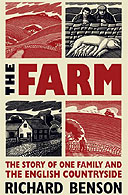
The Farm
Richard Benson
Hamish Hamilton £15.99, pp230
Publishing's passion for memoirs shows no sign of abating; I have read six already this year, of which one was wonderful, three just about passable, and two so awful they should never have been published.
On and on they come, their Pooterish authors bizarrely convinced that what is really only a perfectly nice magazine feature - why I love frocks; my peculiar grandmother; how baking bread saved my life - deserves to be preserved between two hard covers for all eternity. A good memoir is a very fine thing indeed; the fiery alliance of art and life can make your heart race and your fingertips tingle. But reading a bad memoir is like being stuck in a confined space with a total stranger - one with a myriad of verbal ticks and, possibly, a speech impediment - who is dead set on showing you his or her holiday photographs.
In this context, Richard Benson has two points in his favour. First, he can actually write. Second, he has a proper story to tell, and it feels like an important one. As I type, the National Union of Farmers is warning again that small, family-run farms like the one on which Benson grew up, may soon be a thing of the past - the result of cheap grub, bizarre subsidies from Europe and, perhaps most of all, the odd disjunction between our food and the places that provide our food.
Such a disappearance will have huge consequences for the husbandry of our countryside. It will also result in a catastrophic seeping away of wisdom that encompasses everything from the way pigs are housed to the old names for wild flowers. Benson is painfully aware of all this. But because he is not one for false sentiment or for 'heritage - the preservation of the past in aspic - a more wry, trustworthy narrator you could not hope to meet. The Farm charts the quiet implosion of his family as they give up living off the land - the chalky, hardscrabble land of the Yorkshire Wolds - after 200 years.
We meet the Bensons in the 1990s. Times are tough for pig farmers, and the bank manager has told Richard's parents and his taciturn, tractor-loving brother, Guy, that there is nothing more to be done; it is time to sell the animals and their sties, plus all the bits and pieces that litter the farmyard (at auction, even the rustiest egg basket has appeal for a Leeds-based commuter in search of rustic authenticity).
The author weaves his way back and forth through his narrative like a cow in clover, deftly interleaving the story of the farm's demise with episodes from his childhood. Benson, a former editor of the Face, was not a natural farmer's son; he could never get the hang of all that machinery.
Once upon a time, you gather, he was probably eager to escape all this - a fact that, somewhat to his surprise, now serves to heighten his sense of loss.
I wish Benson had weighed down The Farm with more facts, rather than dumping his statistics in an afterword, where they rattle horribly, like stones in a combine. They deserve to be centre stage. (Try these for size: in 1939, there were 500,000 farms in Britain, a figure that now stands at 191,000; it is estimated that three out of four jobs in agriculture have been lost since 1945; the average farmer earns £10,000; there are 50 suicides a year among farm workers.) But this is just to nit-pick.
Benson has written a lovely book, elegiac yet full of life. His greatest achievement, however, is to render his father, a man with a working knowledge of all the nastiest pesticides, a hero of Gabriel Oak proportions.
In an age when most ordinary farmers - at least for the prissy, organic -sausage-buying middle classes - are the enemy, this is no mean feat. For this alone, he deserves a rosette that says: 'Best in show'.
