
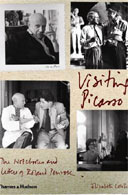
Visiting Picasso: The Notebooks and Letters of Roland Penrose by Elizabeth Cowling
Thames & Hudson £25, pp408
Pablo Picasso, who spent his entire adult life in self-imposed exile from Franco's Spain, once offered to design a flag for asylum-seekers and stateless refugees in the form of a piece of gruyère cheese 'with holes for the countries that have disappeared'. It would have come in handy as the personal standard of his first British biographer, Roland Penrose, who left blanks on principle wherever the factual record looked dodgy or discreditable.
'Ask me the wrong questions,' Picasso warned Penrose blandly before he began, 'and I'll give you the wrong answers.' Visiting Picasso is based on copious unpublished notes and diaries kept by Penrose in the 1950s and '60s, when he was a regular summer visitor to the south of France. They contain a full, frank and gossipy account of intrigue, plots and squabbles among Picasso's entourage of friends, suitors, wives, mistresses and children, all watching and waiting for the painter's slightest glance or gesture. 'Picasso sunburnt with his fringe of white hair round the back of his head, his never tiring black eyes, his red shirt, is always the centre of everyone's thoughts, especially as everyone's movements depend on his, and no one, not even he, knows what it will be.' Sharpeyed, assiduous and astute, Penrose was ideally placed to be, in Elizabeth Cowling's expressive phrase, 'a Samuel Pepys at the court of King Pablo'.
The snag is that Penrose, unlike Pepys, was a born courtier. Fawn and grovel were his natural positions. As a biographer, he never questioned the need to protect and defend his subject with what Cowling calls 'tactful and necessary veiling or expurgation'. He relished the role of semi-official spin doctor. His veneration was bottomless and totally uncritical. If called in question, it could also be brutally aggressive. For Penrose, it was a sacred duty to present Picasso as exemplary in both human and artistic terms ('Not only the achievements, the character of P, his life, is a guide'). He saw himself in moments of exuberance as the campaign manager for a modern Michelangelo. In depressive mode he felt more like a fly crawling over the face of a sphinx.
The hero of Penrose's Picasso: His Life and Work, published in 1958, is 'an unapproachable, semi-mythical being', part sphinx, part minotaur, rising majestically above the triviality and squalor of everyday human life. Picasso told the author that it seemed to him, when he read the book, as if 'we were sitting at the same table and writing it together'.
This was the literary equivalent of his childhood dream of being carried shoulder high above the crowd like the local matadors. What Cowling sets out to do in Visiting Picasso is match dream with reality. The core of this extraordinary book is its precise and patient, almost surgical, exploration not just of a public collaboration but of the price that had to be paid in private for the slavish devotion Picasso needed and got from all his oldest and most faithful friends.
Penrose was a relative latecomer. He first appeared on the fringes of Picasso's court as a comparatively insignificant ambassador for British Surrealism in 1936, and consolidated his position a year later by snapping up a batch of canvases that made his collection of Picassos the best in Britain. He also acquired a new girlfriend (soon to be his wife), the American photographer Lee Miller, whose combination of classical beauty with streetwise poise and verve captivated innumerable contemporaries, including Picasso. Penrose described one of the portraits Picasso made of her in France that summer with proprietary pride: 'On a bright pink background Lee appeared in profile, her face brilliant yellow like the sun with no modelling. Two smiling eyes and a green mouth were placed on the same side of the face and her breasts seemed like the sails of ships filled with a joyous breeze.'
Another prophetic portrait made the same summer touched on darker undercurrents. Lee photographed a bullish Picasso at the wheel of his Hispano-Suiza with Penrose - 'taller, thinner, weakerlooking' - hovering deferentially behind him, accompanied by a faint reflection of the photographer herself in the windscreen. 'In that one shrewd take, she pinpointed ... the self-effacing fidelity of Penrose's love for Picasso - a fidelity which no woman, herself included, would ever inspire in him.'
Extreme inequality was an integral part of the relationship between the two. Cowling compares it to medieval courtly love: 'On one side there was adoration, constancy, the desire to serve and do honour, and long-suffering patience, and on the other ... aloofness ... caprice and cruelty.' Parts of their one-sided correspondence read like love letters. They were separated only by the Second World War. Marooned for five years in London (where he composed a Home Guard Manual of Camouflage that proved to be the unexpected launchpad of his postwar career as one of modern art's prime exponents), Penrose raged and groaned to be in Paris with Picasso. He wooed him afterwards with love-tokens and tormented semi-Surrealist poems ('in the poem he adopts the voice, as it were, of the beloved, voluptuous, ever-responsive, ever-nurturing but dominated and plundered female body'), neatly copied out on expensive paper with coloured decorations.
Presumably there was, as Cowling suggests, an element of sublimated sexuality here, on one if not both sides. Penrose noted without comment Dora Maar's opinion that Picasso (who installed her as his reigning mistress for seven years) was undoubtedly a repressed homosexual. But it was power, rather than sex, that interested Picasso, whose insatiable desire to see his acolytes squirm and dangle found an addictive accomplice in Penrose. The consequences were spectacular. It was Penrose who founded the Institute of Contemporary Arts in 1946 with Picasso as its patron in all but name. In 1960 he transformed Picasso's reputation in this country with a groundbreaking retrospective at the Tate, and followed it up with a triumphal flow of further books, talks, exhibitions, acquisitions and commissions. As the mastermind behind one of the 20th century's major PR campaigns, Penrose could not be faulted.
The repressed and secret story of these years makes fascinating reading. 'I loathe myself for doing this,' Penrose wrote in 1966 in one of innumerable begging letters angling for permission to borrow a sculpture, buy a painting, put on a show or simply pay a visit. He had become by this time, as he said himself, 'a big pain in the arse'. Worse was to come when he set about preparing a second edition of his biography in 1971, revising it under supervision from Picasso's second wife, Jacqueline, painfully aware that a single false emphasis could bring disgrace and banishment.
Picasso's favours in these last years grew sparse and meagre. As often as not Penrose went home to England empty-handed, sometimes without even being let into the studio. Once the dog bit his bottom. He died in 1984, 10 years after Picasso, with his achievements largely superseded or forgotten. He lives again without veiling or expurgation in the pages of this book. As a psychological case study, an art-historical resource, a cautionary tale for biographers or simply as sheer entertainment, Visiting Picasso is hard to put down.
