
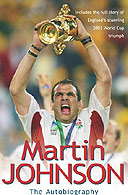
Martin Johnson: The Autobiography
by Martin Johnson
353pp, Headline, £18.99
The title could be more lyrical - Lions and Tigers, perhaps - but Martin Johnson: The Autobiography sums up the man. Solid, honest, unpretentious, the yeoman captain from the depths of Middle England who last month led his country to World Cup glory.
The story of the last chapter of this book is almost as dramatic as Jonny Wilkinson's last-minute drop-goal. On the day after the final, the publishers expected 4,000 extra words on the 2003 World Cup. They received 10,000, dictated by Johnson through his agent. The words were shoehorned into the back of the book and it was on the shelves less than a week later.
Advance orders - of almost double the number who were at Sydney's Telstra Stadium on November 22 - have justified the breathless rush to put Johnson's story into print. Whether or not it is an appealing read depends largely on your rugby allegiance. To England's detractors, which is pretty much any other country that takes the game seriously, Johnson epitomises the ruthlessness of Leicester Tigers, the national team and the Lions whom he led to victory in South Africa in 1997 and to defeat in Australia four years later.
Johnson's aggressive style has often got him into trouble and, in a chapter titled "Terminator in Shorts", he justifies himself with as much passion as he displays on the pitch. The gist of Johnson's argument is that rugby is a physical and sometimes violent game in which only the strong survive and that he is as much sinned against as sinning.
It's a valid line, which Johnson illustrates with examples of notorious thuggery by opponents: on one such occasion, during the 2001 Lions tour, the Australian Duncan McRae repeatedly punched the prone Ireland stand-off Ronan O'Gara in the face. The trouble with this line is that Johnson will more often than not water down descriptions of his own aggression by describing a punch as a "slap" - as in his much-publicised spat with the New Zealand scrum-half Justin Marshall in 1997, an incident that led to Johnson being banned for the following game against the Springboks.
But what rescues this book, apart from the epic tales of victories in rugby's badlands from Pau to Bloemfontein, is the deadpan style, which is often hilarious. Johnson's mentor at Leicester is Dean Richards, the policeman who became the hulking colossus of England's back row in the 1980s and 90s. Richards had a notorious aversion to training. "Tony Russ, our coach at Leicester, wanted the team to go out and warm up together ahead of each game," writes Johnson. "Deano would have none of it. He would turn up, run out and play. 'All you need to do to warm up,' he used to say, 'is sit on the bog, have a crap and read the match programme.'" A familiar excuse that Richards would use for skipping training was that his job entailed him taking criminals into custody. Johnson writes quizzically: "Given the number of arrests he seemed to make, he must have been the scourge of Leicester's criminal classes."
Apart from its humour, the book also demonstrates that there is a lot more to the England captain than beetle-browed enforcer of the second row. Johnson, who resents his description as a "pantomime villain", dedicates the book to his family, and there are moving words about his mother Hilary, an ultra-distance runner who provided Martin and rugby-playing brother Will with their sporting genes. Hilary Johnson died from cancer last year and missed the birth of her granddaughter Molly earlier this year. Molly's birth doesn't seem to have softened Johnson on the field, much to Leicester and England's relief.
· Ian Malin is the author of The Essential History of the England Rugby Union Team, published by Headline.
