
Hear the word "essay" and most of us will think of two things. First will be those glories of English literature which flowed from the pens of Samuel Johnson, William Hazlitt, George Orwell, Christopher Hitchens, and - most glorious of all, for my money - Martin Amis (why on earth does the man bother with novels?)
Second will come to mind those feebler efforts that dribbled from our own pens at school and university. There is a link between the two. Fine writing, one can argue, goes together with good thinking. "How do I know", asked Auden (one of our greatest essayists, as well as our greatest poet) "what I think till I see what I have written?" That is the essence of the essay. Of course the essay is not "rigorous". What did Dr Johnson call it? "A loose sally of the mind". That's the other essence of the essay. Looseness.
Which leads us to the latest report from the right-wing Centre for Policy Studies, who have proclaimed as so much "rubbish" the essays generated by the annual SATs - the public exam for the nation's youngsters.
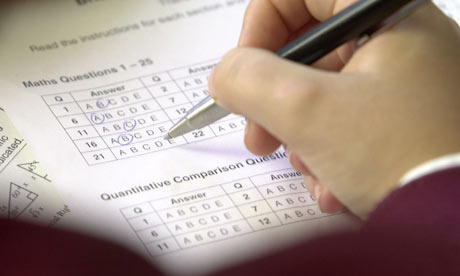
There is no problem, of course, with maths, algebra and other rock-hard subjects, where correct/incorrect, marks-out-of-10 judgments can be applied. "Safety in numbers", as the proverb puts it. But words are slippery things - and essays slipperier than a basketful of eels. Abolish essays, says the CPS (is that a cry of pain I hear from Dr Johnson?) and replace them with multiple choice tests. No loose sallies of the mind there.
Anyone who has worked in education will be familiar with the intractable problem highlighted by the CPS report. Some subjects lend themselves to "objective assessment". Others - involving self-expression, analysis, and fluency - must be graded "impressionistically". Not "right/wrong" but "I like/don't like it". How to make the squishy subjects unsquishy enough for the examiner to grade? The best educational brains wrestle vainly with the problem.
Let's take English - the squishiest of them all. It differs from maths and science (the other two SAT core subjects) in one fundamental way. If you have a class of 20 students and they all produce word-for-word the same essay on Pride and Prejudice in their A-level exam, has the class been a success? No. What you have is not pupils, but a flock of parrots. If, however, in a geometry class, every student produces, independently, the same right answer to a really tricky problem, has that class succeeded? Yes, triumphantly.
With the squishy disciplines, you can have as many different types of A+ essays as there are students writing them. I've given top marks to essays that argue that Miss Bennet is an admirable young lady and others that take the line that she's a selfish minx. Grading them needs to be simultaneously case-sensitive and as fair as best practice can make it. And best practice is extremely time-intensive. In university finals exams, fairness is achieved by timed desk examination, unseen question papers, double (blind) marking by experienced examiners, external monitoring and interminable re-readings, where examiners disagree about whether a paper is, say, B++, or B+.
Do multiple-choice tests, which can be marked at the speed of a cane along a row of railings, work with English? No. Or only at a level barely above the intellectual grunt. You could frame a four-option multiple-choice question for "Who is the nominal heroine of Pride and Prejudice?" But try framing one for "Is Elizabeth really the heroine of Pride and Prejudice?" Which question would elicit evidence of intelligent reading?
The CPS is right to despise the current standard of SAT essay marking. But the solution is not to go multiple-choice. Preserve the essay, I would urge, and improve the apparatus for marking it. Who knows, at the price of a little looseness, you might produce a George Orwell for our times.
