
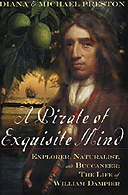
A Pirate of Exquisite Mind: The Life of William Dampier
by Diana Preston and Michael Preston
289pp, Doubleday, £16.99
Who was the first Englishman to eat mango chutney? Not a question, perhaps, to vex your mind with over a curry lunch. But what about the first to describe chopsticks and help to introduce the words "breadfruit", "posse", "barbecue", "soy sauce" and hundreds of others to the language? It was the same man who circumnavigated the globe an unprecedented three times, who first correctly described the winds and currents of the Pacific and who became the first Englishman to land on the Australian mainland. William Dampier seems to have been fated to be first in many quarters, not least when it comes to being forgotten, something Diana and Michael Preston set out to redress in this fine biography.
Dampier was born in East Coker, Somerset, in 1651 and 22 years later sailed away from London in what was to become one of the most adventurous and eventful of lives. He had contracted to work on a Jamaican sugar plantation, a plan that fizzled out in arguments and drinking, a foreshadowing of how Dampier's travelling life would end. But it is the achievements and exploits in between that give the Prestons such a roaring tale to tell.
Like many other impecunious Caribbean drifters at the time, Dampier slipped into a life of freebooting and buccaneering, hopping from ship to ship, raiding Spanish vessels and towns. But already there were signs that this man was different. Notably he kept a journal, a meticulous record of sights, sounds and tastes encountered, plus careful observations of winds, currents and tides. This, as the Prestons rightly point out, is the fascination of the man. Dampier was no East India Company apparatchik or gentleman jotter, observing the unknown globe from the glory of a well-armed poop deck; rather, he threw himself into every experience, often alone, often broke, but always willing to grab his sea chest and move on.
The first experience came chopping timber with desperadoes on the Mexican coast, but soon he was tramping through the jungles of Darien for a sight of the Pacific Ocean, all the while taking notes which he stored in bamboo containers sealed with wax. A lean spell privateering along the coast was followed by a nightmarish trek back across the isthmus, a dreadful journey which gives this book one of its most powerful sections.
Dampier's own account, A New Voyage Around the World, remains as vivid and exciting today as it was on publication in 1697, but the Prestons have managed to augment it with their own thorough research. Not only do they flesh out the characters and personal conflicts that Dampier often skips, but their own travels often give a powerful understanding of Dampier's feats.
Blessed with the constitution of a sea lion (he coined the name for the beast), Dampier pressed on with his adventures, sailing around Cape Horn to the Pacific, then westwards. Here again one can only marvel at his determination and strength. This was no pre-planned circumnavigation with wealthy backers: Dampier and a motley group of companions set out already half-starved and with little more than the tales of Drake and Cavendish to sustain them. For anyone who believes true travel experience comes without intermediaries - be they corporate sponsors, travel agents, or, in Dampier's day, the merchant companies or the Admiralty - this man must be a hero, an inspiration for rambling loners everywhere.
His Pacific crossing ended with him, alone again, walking to the Chinese city of Cachao. En route he spied a stall displaying large hunks of pork and grabbed a haunch, offering to pay, only to be beaten and abused: he had actually stumbled on a funerary pyre. Eventually he arrived back in England with a companion, a tattooed "prince" who had been snatched from his eastern island home and sold into slavery. Dampier planned to show him and make a little money, a fact that tends to dampen enthusiasm for the Prestons' claim that he was something of a trailblazer when it came to racial tolerance.
Nevertheless, they are right to make Dampier an influential force in modern thinking. The piratical communities he wrote about had democratic and egali tarian tendencies (as well as vicious, violent ones), and Dampier's accounts certainly influenced authors such as Defoe, who would milk the romance while disseminating the radical ideals. (Indeed, without Dampier Robinson Crusoe might never have been written: it was Dampier who set in train the events that would lead to Alexander Selkirk being marooned on what was then the remote and uninhabited island of Juan Fernandez. Almost five years later, it was Dampier who helped to rescue the poor man and so save his story for Defoe to plunder.)
Once back in England after that first impromptu circumnavigation, Dampier was quickly separated from his tattooed milch cow by unscrupulous business acquaintances and narrowly missed a charge of piracy. He had more luck among the scientists of the Royal Society, gathering friends and admirers for his observant and rational approach to travel. Once again the Prestons are superb at building a picture of the times, especially the foment of ideas and information that found fertile ground in the coter ies and cliques of Restoration coffee-shop culture. Had it not been for the enlightened men of the Royal Society, Dampier's career might have foundered. As it was they recognised his talents and applauded his achievements. Dampier dined with Samuel Pepys and John Evelyn, discussed colonies with John Locke and botany with Sir Hans Sloane.
Having become an associate member of mainstream bourgeois society, however, he soon discovered that he would always remain an outsider to some, for ever tarred by his early buccaneering days. On his first voyage as leader, and in a Royal Navy ship, he found his deputy "did not care a fart" for a non-navy captain and was ready to create trouble.
It was the beginning of a long decline. Dampier either didn't realise his own limitations or was carried away by success. Leadership was not his strong point, and the remainder of his career was marred by endless mutinies, resentments and court battles. Still, he made it to Australia and Papua New Guinea, returning with the first ever botanical specimens from the new continent. Too wayward and individualistic to become a James Cook, Dampier did not achieve the success that was waiting to be had in terra australis, or New Holland as he knew it. One senses he was never so happy as when exploring alone. Nevertheless, he returned with material for a further book, A Voyage to New Holland, once again setting a standard for straightforward reliable narration and firsthand experience that would serve any aspiring travel-writer well to this day.
Dampier's life sank quietly in the end, without honours, without even the date of his death recorded. The Prestons quote one source from 1907 dismissing him as "a pirate ruffian that ought to have been hung" - a sorry judgment on the man whose books Darwin chose to take on the Beagle. For all his faults, Dampier was treated dismally by parts of the establishment and deserves to be recognised as the great explorer and innovator that he was. This gripping and well-researched narrative is an impressive achievement and an excellent start to that process.
· Kevin Rushby's Hunting Pirate Heaven is published by Constable & Robinson.
