
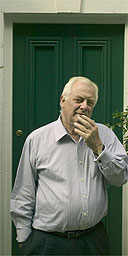
Chris Patten has just had shoulder surgery, is in a lot of pain and has hardly slept a wink, but he is nothing if not a trouper. He is going to do this interview, though he admits to being "yawny" and speaks with what seems excessive deliberation; he also agrees to have his photograph taken in the wood opposite his large house in Barnes, south-west London, and poses gamely against several identical-looking trees. He doesn't even complain when the photographer treads on one of his dogs. As I suspected, Patten is far too nice to be a politician.
That is one of the prejudices with which I approached this encounter. The other is that he was mad not to fight a byelection after his surprise loss of Bath to the Lib Dems in 1992. That defeat, when he was chairman of the Conservative party, dramatically altered his career, taking him away from Westminster and into that nebulous world of the great and the good.
Over the next decade he was governor of Hong Kong, chairman of the independent commission on policing for Northern Ireland, and European commissioner for external relations. Now he is chancellor of Oxford University and co-chair of the International Crisis Group, which attempts to identify and prevent potential conflicts. All these jobs smack of goodness - but greatness? Surely not. So why didn't he stand again? If you slide down the greasy pole (or, in this case, poll), why not start clambering up once more? He was certainly young enough - just 48 when he lost Bath.
"One reason why I was keen to go to Hong Kong after '92, despite entreaties for me to stay and fight a byelection," he explains, "was first that I thought there was a terrific chance of losing a byelection, even in somewhere like Kensington and Chelsea. But, secondly, to have been hanging around like a wallflower would have been rather demeaning and there were other things to do. In many respects, I've had a more interesting career than I would have had."
Patten's rise had been meteoric: he joined the Conservative research department in 1966 at the absurdly tender age of 22, was its director from 1974-79, became an MP in 1979, a minister in 1983, environment secretary in 1989 and party chairman in 1990. Had he retained Bath in 1992 he would, John Major said in his memoirs, have been chancellor (Patten wonders whether he could have prevented or at least ameliorated the ERM debacle). Had he successfully fought a byelection, he thinks he would have succeeded Douglas Hurd as foreign secretary. But he doubts whether he would have been elected as Tory leader - too wet, too leftwing, too pro-European.
He is, we agree, certainly to the left of Tony Blair, and I wonder how he managed to serve for seven years in Thatcher's government. He is unapologetic. "I wish Thatcherism hadn't been quite as bruising and I wish it hadn't gone quite as far," he says, "but it was justified and necessary; I'm sure she was beneficial. She made it possible to govern Britain again and released some notions from the broom cupboard of history, like market forces, tax cuts and employment law, which would otherwise still be locked up today. Like several of our recent prime ministers, she was weak on institutions and had no real sense of the difference between value and price. But overall I think the 80s were good for Britain, as clearly do Mr Brown and Mr Blair."
Patten quotes the old Tory saw that in saving the country, Mrs Thatcher destroyed the Tory party. He doesn't subscribe to it completely, but he comes close. "Regicide helped to make the Conservative party unmanageable for a decade, and if you add to that the difficulty which the party has had in putting together a narrative which offers a distinctive alternative to Mr Blair, that does go some way to explaining why we've done so miserably badly."
He believes the 2005 election, far from being a step on the road to recovery for the Tories, was a disaster. "The result was particularly depressing," he says, "because the Iraq war had knocked a lot of the gilt off the gingerbread and come close to losing the prime minister the benefit of the doubt. The Conservative party should have done much better. Indeed, I think it's possible that if Europe hadn't prevented the best candidate from being elected leader in 2001 and again in 2003, we could have won the election." No prizes for guessing that he is referring to his old cabinet colleague Ken Clarke.
So who will he support in the coming leadership contest? "I wouldn't want to damage anybody's prospects by being too noisy a supporter," he says, "but I think both David Willetts and David Cameron have the great advantage of being thoughtful and sensible. David Willetts makes comprehensible speeches about the sort of issues that politicians should worry about but can very seldom summon the political energy to get involved in, like the impact of demography on social policy. I suspect that David Cameron will be thought more charismatic as a potential leader, and it may be time to jump a generation and go for somebody much younger. He's an extremely decent, intelligent man, and he's got very good political judgment. It sounds rather a sanctimonious thing to say, but he's a good human being."
The other David is dismissed rather summarily. "I don't really know him," he says. I press a little - can David Davis's more populist approach revive the party's fortunes? His reply is oblique yet emphatic. "The Conservative party keeps on electing leaders of the opposition, and it's about time we elected somebody who would be a prime minister. I don't think the Conservative party does itself any favours by talking to itself."
Patten is convinced that the elusive Conservative narrative - "tolerant, efficient, generous-spirited" - can be refashioned, and that the absence of a New Labour philosophy presents an opportunity. The Tories may be dazzled by Blair, but they have nothing to fear from Blairism because it doesn't exist.
"Blair is an extraordinarily talented politician," he argues, "but you have to do something else in politics. You have to have some convictions which you're trying to follow through, and I have a problem with someone who can start off with a CND badge and be anti- European and, when challenged about it, will just say, 'Well, I had to do that to get elected.' I wouldn't have said in the 1970s when I was looking for a seat, 'Oh well, I'll be in favour of capital punishment in order to get a safer seat.' Still, autre temps, autre moeurs, as they say in Brussels."
Patten is damning about the present Conservative leader's opportunism, not least over the financing of higher education. "I was horrified when Michael Howard opposed top-up fees," he says. "It was tactically foolish because, if you were trying to embarrass the Labour party, there would have been a much bigger Labour rebellion in the House of Commons if the Conservative party had supported it. And it was strategically unwise because you can't go on talking about introducing market forces into the provision of public services and then oppose top-up fees. It's ridiculous. It's very important for the Conservative party not to be opportunistic. As George Osborne said recently, populism is bad enough, but unpopular populism really is a sin against the Holy Ghost."
The Holy Ghost looms large in Patten's worldview: his Catholicism has always informed his communitarianism and belief in the social market. Perhaps, too, it underpins the civilised nature of his politics. His two years as party chairman, when he had to indulge in political knockabout and learn the meaning of the word "gobsmacked", were not perhaps his happiest time. The late Hugo Young, a fellow Catholic, blamed the electoral thuggery to which Patten had to resort for his defeat at the hands of the voters in genteel Bath.
The Daily Telegraph once said sneeringly that Patten was not a true Conservative but a European Christian Democrat - he had committed the cardinal sin of lauding Germany and the social market - but he rejects the label. "I'm critical of the attempts to develop Catholic social policy over the last century," he says. "It is difficult to cross the bridge between the New Testament and policy wonkery. But I am a Christian, I believe in the social market and I think we do tend to forget the difference between value and price, not just in the Conservative party but across the spectrum in this country."
Patten, who is 61, now sees his role as "speaking, writing and making trouble from time to time". He welcomes the fact that he can do the big-picture stuff and ignore the "daily blips on the radar" that force frontline politicians off course. "It's one of the luxuries of being in my position that you can be a smart aleck," he says. In September, he publishes a book called Not Quite the Diplomat which attempts to pull together many of his preoccupations - Britain's role in the EU, the transatlantic alliance, national sovereignty and the extent to which that issue helped to wreck the Conservative party in the 1990s, the dangers of US unilateralism, the need to involve China and India in global governance.
In the past, Patten has raised what he calls the "existential question" of Britain's role in Europe - why we still, after more than 30 years, feel uncomfortable as a member of the EU. He draws some comfort from the fact that France and Germany are now having their own existential doubts, and believes that, despite the constitution being "as dead as Mr Cleese's parrot", there are encouraging signs.
"The paradox is that, in practice, the constitution spells the end of the federalist tendency in Europe," he says. "There isn't a serious political leader in Europe who could fight and win an election arguing that we should make a great federal lurch. I think we now have momentum behind what you would loosely describe as an open British agenda - continued reform of the common agricultural policy, opening up markets, completing the single market, building a European Union which is not corporatist, protectionist or nationalist. There is a huge opportunity for us. The snag is that at precisely this moment when it should be a downhill roll, Iraq means that for a lot of Europeans, the UK and Mr Blair are a bit suspect."
Patten clearly does not believe that the EU is about to unravel, but he has two concerns: first, that Turkey will not be accepted as a member - he believes Turkish membership is crucial in countering the theory of an inevitable "clash of civilisations" - and, second, that there is still no sense of Europeanness among voters. "It's terribly difficult to make people feel that they are controlling the institutions which are required in order to run what we have agreed to do in common," he admits. "We've got to be much more imaginative about that. Most things cross borders, but politics don't seem to."
When I approached Lord Patten to set up this interview, I wrote a rather pompous email suggesting that, uniquely, he was at the confluence of some of the great questions of our time - whither Europe, whither the Tories, whither higher education? Thereafter, in our correspondence, he always signed his emails "Confluence", a nicely deflating touch. He takes himself seriously - witness the basso profundo animadversions and the pictures in his lounge of himself with the Dalai Lama and Bill Clinton - but not too seriously. Which is perhaps why he could cope with slipping off the greasy pole. I still think he was mad not to have another go, but at least Lord Confluence's civilised brand of politics has not been lost completely. Not Quite the Diplomat is published in September (Penguin, £20).
