
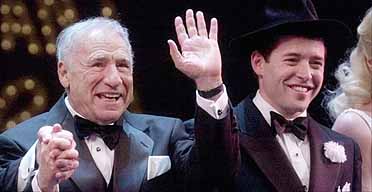
One show currently dominates Broadway: Mel Brooks's The Producers. Bookings are being taken up to the end of time. I even heard of one man paying $400 for a black market ticket and feeling he had been undercharged. Surely, even with its record-breaking 12 Tony awards, it couldn't be that good? But it actually does live up to all the ballyhoo by offering three hours of impure, time-suspending pleasure.
Why, though, has this show captured the public imagination in a way no Broadway musical has in years? One answer is that it is a throwback to the heyday of musical comedy. After years of shows that lecture us about 19th-century poverty or Saigon decadence, this is a musical that makes us laugh almost continuously. It also makes a bonfire of good taste. And, at a time when most musicals are symbols of a rootless, airport culture, it is defiantly American - although it also stirred memories of the kind of lavish variety spectaculars that I saw at the Coventry Hippodrome as a child.
It starts with the great advantage of being based on the 1968 Mel Brooks movie about the no-hope producer Max Bialystock and the nervy accountant Leo Bloom, who plan to clean up by persuading angels to over-invest in an iron-clad flop: Springtime for Hitler. But it improves on the original movie. It focuses less on the incomparable Max and more on the neurotic Leo, who feels that Bloomsday has finally arrived when he becomes a producer and falls in love with the pneumatic Swedish secretary Ulla.
The musical also removes a dead patch in the film where Dick Shawn's ageing hippy plays Hitler. Here, the role is played first by the show's tin-helmeted Nazi author and then, when he literally breaks a leg, by the preposterously camp director. Above all, the musical turns the little old ladies, whom Bialystock has to seduce to raise capital, into a running, or possibly shuffling, gag. Every musical needs a moment of pure ecstasy; and it arrives here, in Susan Stroman's exuberant production, when the sex-mad grannies launch into a dream-sequence tap-dance - with zimmer frames.
But while The Producers is an authentic crowd-pleaser, its success depends on a series of intriguing paradoxes. The main one is that it is both corny as hell and extremely sophisticated. Early on, for example, we see the aspiring Bloom quitting his accounting sweatshop - a bureaucratic hell full of towering desks that, in Robin Wagner's brilliant design, reminds one of Elmer Rice's The Adding Machine. Spangled chorus-girls then step out of the filing cabinets in fulfilment of Bloom's erotic theatrical fantasies. But the high point comes when downtrodden Bloom, accused of going to the rest room, heroically announces: "I'm not going to the toilet - I'm going into show business." Matthew Broderick's immensely subtle Bloom acknowledges the comparison with just the faintest heavenwards glance.
But the subversive nature of Brooks's humour only really emerges in the Springtime For Hitler sequence. We laugh as Teutonic chorines descend a flight of steps bearing on their heads tankards, sausages and vast Wagnerian horns to the lyrics: "We're moving to a faster pace/ Look out, here comes the master race." Stroman even echoes a mock-Busby Berkeley overhead shot from the movie by showing goose-stepping stormtroopers reflected in a tilted mirror. But what seemed absurd in 1968 now feels like an ironic comment on showbusiness's flirtation with fascism. The Sound of Music gave us comic-book Nazis. Cabaret, still running on Broadway, both assaults and exploits Weimar decadence. And Evita was a hymn to a dictator. By making us complicit in the presentation of a ghastly Hitler musical, Brooks plays on our collective guilt and reminds us of the theatre's dependence on the sound of Munich.
As Bialystock, the ebullient Nathan Lane does wonderful vaudevillian shtick. But Broderick, who amazingly didn't win a Tony, gives a more graceful performance as the burgeoning Bloom, who finds his fantasies becoming reality. And, while the show defies political correctness, it also asks whether Broadway audiences now leave their moral consciences behind in the cloakroom. The narrative pay-off is that Bialystock and Bloom turn into legendary producers with a string of musical hits to their credit, including such neon-lit titles as Maim, Katz and High Button Jews. Tasteless? Possibly. But I suspect it is Mel Brooks's final comment on Broadway's ability to turn everything into show business.
The only problem with this blissfully enjoyable show is that you can't get in and that it inevitably dwarfs everything else on Broadway. Plays, in particular, are now an endangered Broadway species, with 87% of the total box office going to musicals and a derisory 13% to straight drama. But David Auburn's award-winning Proof deservedly survives at the Walter Kerr Theatre. It is an intelligent piece about the depressive 25-year-old daughter of a brilliant Chicago maths professor; and the key question is whether she, or her late father, is the author of a revolutionary mathematical theory.
Auburn's play invites comparison with Stoppard's Arcadia and Frayn's Copenhagen. Regrettably, the invitation has to be declined. Where they are unafraid to spell out scientific or mathematical theory, Auburn ducks the details. But he has written an engaging play about genetic inheritance and the complex love of fathers and daughters; and Daniel Sullivan's back-porch production boasts a beautiful performance from Mary-Louise Parker as the shy, reclusive daughter who nurses a secret genius.
Sullivan directs the Broadway revival of another play that also tells us that "a father's love for a grown-up daughter is the most dangerous of all infatuations". The piece in question is Shaw's Major Barbara, here presented by the Roundabout Theatre Company. Shaw is always thought of as a heartless brainbox, but, watching Sullivan's revival, I was struck yet again by his profound emotionalism.
Of course, this 1906 play is partly an attack on "the crime of poverty" and a prophetic portrait of global capitalism. But at its heart is the intense relationship between the munitions manufacturer, Andrew Undershaft, and his daughter, Barbara. David Warner, making his American stage debut, poignantly puts the emphasis as much on Undershaft's paternal love as on his industrial power; and if Cherry Jones is too mature for Barbara, her capacity for listening dignifies a decent revival.
But the overwhelming impression of New York theatre - as they sing in the satiric Forbidden Broadway - is that "the same old war-horses run and run". All too true: Les Mis, Phantom, Beauty and the Beast, Annie Get Your Gun, Chicago et al are, like the Shavian poor, always with us. For one looks instead to Off-Broadway, where I caught an unexpected treat in a 90-minute musical called Tick, Tick... Boom!, written by the late Jonathan Larson before he hit the big time with Rent. I much prefer this to its overblown successor. It's a patently autobio-graphical piece about the terrors of hitting 30 and feeling a failure. Its 12 numbers bring a rock idiom into musical theatre and the soaring hit, Come To Your Senses, is blazingly sung by Amy Spanger.
I had less luck with John Guare's Chaucer in Rome at the Lincoln Center's Mitzi Newhouse Theatre. The play is a sequel to Guare's The House of Blue Leaves, in which the hero tries to kill the Pope during his 1966 visit to New York. Here, the same character returns to Rome during the millennial celebrations. But, in an over-plotted play, Guare is also dealing with the democratisation of art. We see an artist, having developed cancer through the toxic qualities of his paint, acquiring world fame by videoing the confessions of papal pilgrims and passing them off as art. Even in our gullible age, this is too much to take. The bad news for Guare is that Neil LaBute's The Shape of Things, shortly due in New York, tackles a similar theme with infinitely greater elan.
But, in another branch of the Lincoln Center, real drama is on offer in an ambitious two-week Pinter festival curated by the Dublin Gate Theatre's Michael Colgan. Nine productions, 10 films and five symposia add up to a rare celebration of a living writer. And the opening event achieved that rarest of New York tributes, a heartfelt sitting ovation.
A Kind of Alaska, based on the work of Oliver Sacks and showing its heroine awakening from a 29-year sleeping sickness, was notable for a mesmerising performance by Penelope Wilton. She caught to perfection the character's sense of her being a traveller perplexedly returning from a strange, undiscovered country.
And Pinter's own performance in One For the Road, faithfully supported by Lloyd Hutchinson and Indira Varma, has grown even in the short time since the London premiere. In New York, Pinter's brutal interrogator, ominously clutching a whisky bottle by its neck, acquired an extra bounce and swagger, as if to suggest that this man got a sexual kick out of his deadly trade. In a city where showbiz automatically rules and the sound of music is universal, it was salutary to be reminded of the power of the spoken word and of the stark reality of fascism.
