
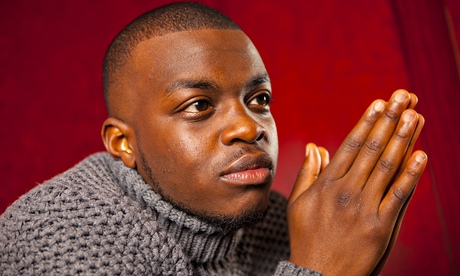
I’ve been writing poems for 10 years. It started with rap music: I was 14 years old, listening to artists like Dizzee Rascal, Tupac and Nas. The music was entertaining, but it was the poetry that got me. I began to understand language as a tool for sharing thoughts; even though you can’t see me right now, by reading this piece, you are reading my mind. This is your brain and my brain connecting.
Some people use poetry to express heartache, but I use it to broadcast a message. My message is that everyone has something to contribute. Much of society is a zero-sum game: for someone to win, someone else has to lose. I don’t think this is necessary – there’s no need for anyone to lose.
It’s important to realise that poetry isn’t something alien which needs to be appropriated; it’s innate. As long as you feel, there is poetry inside you. And if you have a message of protest, poetry can be a powerful way to get it out there.
Writing a poem starts with a question: what’s on your mind? It’s a deceptively simple question, but an important one. You need to clear your mind of any distractions and listen to what is going on in there. Although I normally have a notebook nearby, I avoid staring at a blank page. It’s an intrusion. The page doesn’t have the answer – you do. I have my best ideas in the car, or wandering around the house, just thinking.
Sometimes I listen to familiar old songs – something like A Change is Gonna Come by Sam Cooke – which take me back to another time, so I can listen to my old thoughts, like a time machine.
You shouldn’t think in isolation. You need to interact with the world, and luckily we’ve got the arts and the internet for that. I watch The Godfather a lot, because I find something new in it every time. So just open your mind, jot down your thoughts and get going.
Don’t think too much about your audience initially. Think about yourself. Wrestle with your ideas. Unpack them. Look for all the ways in which they don’t work, or could be taken differently. Then think about the outcome: are you happy to embrace the backlash that might come from your thoughts? You may be comfortable using profanity in private moments, but what about in public?
You don’t have to rhyme in your poetry, but I often do. My gateway to poetry was rap; I loved rap partly because the rhymes were so entertaining. At first I didn’t realise how much information I was taking in – it was just about the words. If you’ve got a message you want to broadcast, there’s no need for it to be boring. Rhyming can make your delivery engaging, and the more you engage, the more you affect. Rhyming is also a great way to teach someone something because it’s fun to listen to, but it can also guide one’s thoughts. If a particular line gets your attention, you will listen carefully just to see how the rhyme is concluded.
Rhythm performs a more visceral function: it’s a vibration that can affect your audience, inciting humour, excitement or even dread. Explore your own rhythm to find out how best to wield this power.
If you are looking to perform your poetry, consider that from the outset. There’s nothing like talking to people – it’s disarmingly honest, because you can’t fake your voice. Make sure the poem is human; don’t lose yourself in the form. And you have to be comfortable with your voice, so don’t say anything that you wouldn’t say in conversation.
I’ve got a crush on words. I really fancy them. I like playing with them and finding connections. But even so, you don’t need lots of words to write poetry. You choose your words according to a) who you are, and b) what you are trying to say.
Writing and performing a protest poem has to start with your self-esteem – not just self-confidence, but your self-worth. Perceive yourself as someone worthy of having a voice, and embrace your nerves – I get them all the time. When I’m nervous, I remind myself that I’m here to address all the bad things that I saw growing up. In a strange way, that is a calming thought. It makes me think: “Oh yeah, that’s why I’m doing this.”
The best protest poems, chosen by Stephen Moss
1. The Masque of Anarchy - Percy Bysshe Shelley
Inspired by the 1819 Peterloo Massacre, where 15 parliamentary reformers were killed by cavalry. Called the greatest ever political poem.
2. The Lonesome Death of Hattie Carroll - Bob Dylan
Written in 1963, it laments the murder of black barmaid Hattie Carroll by a young tobacco farmer, who only served six months for the crime.
3. Suicide in the Trenches - Siegfried Sassoon
This poem, one of several written in 1917-18, expressed Sassoon’s anger at the horrors of the first world war and the death of friends in the trenches.
