
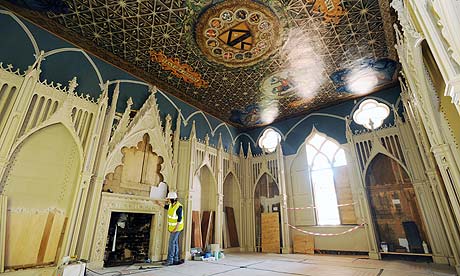
Horace Walpole, connoisseur, art historian, gossip, and author of 4,000 of the bitchiest and wittiest letters of the 18th century, would have been mighty surprised to see a six foot gilded weather vane lowered from a crane onto the tower of his extraordinary home this week, 212 years after his death.
The glittering weather vane, wreathed in strawberry leaves, marks the halfway point in the £8.2m restoration of one of the oddest and most influential houses in the country, Strawberry Hill, deep in west London suburbia.
Every white-faced teenage Goth hanging around a suburban shopping mall owes a debt of respect to Horace Walpole. He found two little cottages by the Thames in 1747, and left a fantasy of the medieval world, bristling with battlements and pinnacles, with a staircase copied from Rouen Cathedral, a drawing room ceiling borrowed from the Henry VII chapel at Westminster Abbey, and library bookcases from the tombs of princes in Old St Paul's.
The fantastic interior, where guests moved from dim hallways painted to imitate stone and barely lit by single candles and light seeping through stained glass, into fan-vaulted state rooms blazing with light and colour, gave the world the Gothic revival style, still named Strawberry Hill Gothic in its honour. Walpole had the first suit of armour used as interior decor on the stairs, a feature faithfully copied in every haunted house movie. It also gave its creator nightmares, one of which inspired him to write the world's first Gothic novel, The Castle of Otranto. The architectural and literary styles both became crazes, and Jane Austen's first novel, Northanger Abbey, with its heroine craving horrid secrets to make her blood run cold and finding only old laundry lists, mercilessly parodied the genre.
He had A-list literary neighbours. Resident or summer visitors on his riverbank included Henry Fielding, Jonathan Swift, and the bluestocking travel writer Lady Mary Wortley Montagu, while Alexander Pope's home was just 200 yards away.
"I keep an inn," Walpole grumbled, "at the sign of The Gothic Castle." The house was open to the public – "any curious Persons ... they who have tickets are desired not to bring Children" – complete with a guidebook, gardening manual, and list of rules written by Walpole himself. His style was widely imitated in his lifetime, but he never expected it to last, predicting: "My buildings are like paper and both will blow away 10 years after I am dead."
It certainly wasn't built to last, with the apparently solid stone actually concealing red brick, lath and plaster, and medieval vaulting reproduced in papier mache. Victorian and 20th-century additions and alterations did the fragile structure no favours, though it was saved from demolition to make way for the surburbs now lapping its boundary wall, through becoming a Catholic training college in the 1920s. By the 1990s, it was rotting and leaking, one of the most important Grade I-listed houses on the English Heritage Buildings At Risk register, and five years ago it made the World Monument Fund's register of the 100 most endangered sites in the world.
Now a small army of craft workers is swarming over the structure, restoring original features buried under layers of crude later work, including the superb Renaissance painted glass which Walpole imported by the boat-load. The trust which now has Strawberry Hill building on a long lease hopes to reopen to the public next summer.
Walpole's collection was as famous as his house, and included a comb that he believed Pope Gregory gave to Saint Bertha, Cardinal Wolsey's red hat, a spur from William of Orange's boot at the Battle of the Boyne, as well as a room full of Holbeins. The treasures were scattered in a famous sale which lasted almost a month in 1843, but many will meet again in a spectacular exhibition on Walpole, curated by Michael Snodin who is also chair of the trust, which opens next month at Yale in the US, and at the V&A in London in March. This time both curious persons and their children will be welcome.
• www.vam.ac.uk/exhibitions/future
