
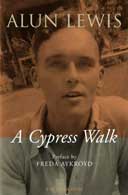
A Cypress Walk: Letters from Alun Lewis to Freda Aykroyd
by Alun Lewis, with a memoir by Freda Aykroyd
272pp, Enitharmon, £20
A Cypress Walk is a wonderful collection of letters written mostly during 1943 by the Welsh poet and short-story writer Alun Lewis to Freda Aykroyd, whom he had met and fallen in love with when stationed in India (they were both married to other people). Lewis died in Burma in March 1944, most likely through suicide, and these letters offer an extraordinary insight into the final year of his life. The book opens with a moving memoir of their relationship written by Aykroyd, who died in 2005.
Lewis first met Aykroyd on July 25 1943, in the village of Coonoor, high in the Nilgiri Hills in southern India, where she lived with her husband, Wallace, director of the Nutrition Research Laboratories, and their daughter Gilly. She held a kind of open house for recuperating officers and nurses, and Lieutenant Lewis arrived recovering from a broken jaw.
They were instantly attracted to each other. As Aykroyd writes in her introduction: "Though much has faded from memory his arrival stays as vivid as lightning." They spent several idyllic days wandering through the lush landscape that surrounded them - "The quality of the air at that great height is difficult to describe. It caused an excitement, an ecstatic appreciation of life ... We pushed the war away as far as we were able, though we were acutely aware of it, as we were aware that this love was wounding to the other loves to which we were committed."
When Lewis returned to his regiment his letters, entrancing and vivid, started pouring in. They reveal a man wrestling fiercely with a whole range of contradictions both within himself and those around him. Even in a state of intoxicating celebration, Lewis's anxieties were never far away:
"That tranquillity was so deep, I can't fathom it, and that ecstasy so unearthly that I can't answer it with the ordinary answers. I know I am involved utterly and entirely in what is happening, and I know that more depends on it than just life ... Because it's hard to breathe, Freda, and there is nothing that can save today, darling, you not being here."
The writing is enthralling. Lewis is constantly evoking possibilities, keeping the connection between them alive. Contradictory versions of self pass in and out of focus with exhilarating urgency. The idea of rooms is important, rooms that are suddenly conjured, vivid and brilliant, out of thin air. Gradually, however, these possibilities, these rooms, become harder and harder to access. This is from a letter of December 30:
"Freda's room was locked, and Alun's, and the new room and the old room and the everlasting room ... I'm afraid of the fighting when it comes. I'll loathe it so utterly, & be so faithless to Life, beloved Life. It is spoiling me already. Yet I refused the chance to escape it."
Lewis had turned down the offer of promotion and a position away from the front in the belief that only through fighting could he find any real self-respect. We see him sinking into sustained bouts of depression. The letters become less and less frequent. Delight in multiplicity disappears in a series of unresolved conflicts:
"The problem is so utterly simple darling, and so utterly insoluble. I would come to you through all evil elements and death-surges ... When I am with you the problem has ceased to exist. We are. That is complete. At all other times this love is a cruelty to the other love I receive and have given, which so powerfully shaped and directed me ..."
We do not have Aykroyd's letters to Lewis. He destroyed them in case they were forwarded to his wife Gweno - "I watched the words fade from your letters, each one as I burnt them. They grew nearer & nearer to me all the time. The ashes were delicate and intangible. The wind blew them about."
His last letter to Aykroyd is extraordinary. In it he tries to find points of reference, points of insight, above and beyond the circumstances that were making things impossible for him:
"Don't be fretted with loss Freda; I feel wonderfully happy whenever the certainty moves in me that I have lived indestructibly in thee. And in mother, & Mair, and boyhood, and Gweno, and words sometimes joining in flame."
In one of his best short stories, "The Earth is a Syllable", the central character, fatally wounded, chooses to get up from the ambulance during the night and to walk into the jungle to die. It was written before Lewis had met Aykroyd and it imagines a homecoming to Gweno and the Welsh landscape:
"He wanted to get up and enter the darkness and enter the silent village under the hill and enter it with his wife alone ... So he pushed himself up on his spare arm and sweated all over; Judas! It hurt."
What matters here is where the mind places itself at the point of death. That much, the story implies, the man was still free to choose. In his last letter to Freda, Lewis rewrites this impulse. The return is no longer to the Welsh valley but to that house high in the Nilgiri hills. He conjures a final place to be in, one that she could share but only in the act of reading:
"For you I wanted to come & see you first, but it will be very wonderful to come in the end. Don't worry over the hairs on my head. May you not be tried harder than you can bear. And I'll surely come up through the trees to the lawn & splendour & the homecoming & the child & Gilly & us."
On the morning of Saturday March 5 1944 Lewis was found unconscious, wounded in the right temple by a bullet from his own revolver. He died six hours later. Although the official verdict was accidental death, there has always been a strong belief that it was suicide, a belief that the publication of this very moving collection of letters seems to confirm.
