
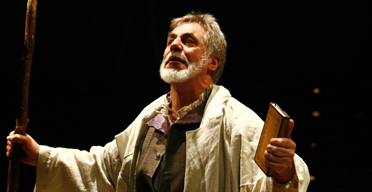
Barrie Rutter, the Humberside Wolfit and barnstorming founder of Northern Broadsides, opens in The Tempest at the New Victoria theatre in north Staffordshire tomorrow night.
He is, of course, playing Prospero. But do not fear that Rutter, 61 this year, has taken up Shakespeare's depiction of the old man surrendering his power to enchant in order to sing his own theatrical swansong. "My revels aren't ended yet," he says, sitting in a dressing room after a busy rehearsal with his Ariels (there are three of them). "I'm not breaking my staff or burying my book - it's just a play."
Neither, round-the-houses questions finally elicit, is it a farewell to life itself. Last year word went round that Rutter had been diagnosed with prostate cancer, so it seemed reasonable to assume that he might have taken on Prospero as dark clouds of mortality gathered. It took a bit of time before he cottoned on to where the bumbling questions were heading. And then he laughed. It emerged that any Prospero-prostate link was, well, total bollocks.
"It's not true but I could see where the fancy and the poetry could come in there," he says, the trademark upturned eyebrows heading for the ceiling. In January he was told that whatever was there was not malignant but that he might still have the possibility of cancer in some cells. "When you are told that you have a malignancy, you don't want to hear it. It knocks you for six. But I'm under supervision and I'm glad of that."
And so are those regulars (not just in the north) who turn up for Northern Broadsides shows knowing they can expect both invention and integrity, as well as - something not always acknowledged - textual fidelity.
Perhaps there's a message for them in Prospero's curious curtain speech:
Gentle breath of yours my sails
Must fill, or else my project fails,
Which was to please.
The unfailing Northern Broadsides project has pleased (most of the time) ever since it was launched with Richard III in 1992 to prove that Shakespeare's language could flourish in the northern voice. That seemed pretty daring at the time but the battle has long since been won. "It's still important but I don't shout about it much these days," says Rutter.
But, he adds, the company's significance is greater than the sound it makes. "We are part of the fabric now. We have a very secure and growing fan base. And for that much thanks. We wouldn't have been going for 15 years if something had not been artistically working. You cannot just buy people's interest in you. That is not to say that we are not as vibrant and as filled with vigour and gusto as ever."
Arts Council funding is secure for three years and Rutter's vision will take him and his company well into his pension book years. "I'm not short of things to do, I'm not short of imagination and I have a six-year plan. We have new commissions out: a new version of Lysistrata from Blake Morrison, provisionally titled Lisa's Sex Strike, in the autumn and next year a dramatisation of David Pownall's novel The White Cutter."
With luck and some desperately-sought cash, this Tempest, a co-production with the New Vic, travels to Beijing and Shanghai in the summer and Rutter hopes the company will be back there in 2008.
And then of course there is Lenny Henry as Othello. Nothing definite yet, but hopes are high. It started when Henry did three Radio 4 programmes (recently repeated) in which he tried to overcome an aversion to Shakespeare bred at school in Dudley. For the second programme, Henry was coached by Rutter in the Moor's final speech ("Speak of me as I am; nothing extenuate...") and was heard to say in some amazement: "Rutter has asked me to do Othello with him."
"Do" here means perform in, take the leading role in, Othello - right, Barrie? Well: did you ask him? Are you going to let him do it? "Yeah. As soon as he is free. We'll do Othello with Lenny. He really wants to do it."
The old actor-manager has not lost his touch. But come on, Rutter, even you must get fed up with trundling round the country for 14 weeks at a time, getting in, getting out, different bed every week, endless motorway miles. Not a bit of it.
"It's what we have done, what we always do. Without wanting to wish your life away, it's better than playing 14 weeks in one place. The excitement, the difference of a change, going through the seasons in different places. We are in Truro for the first time at the end of April - I've never been to Truro before - and Richmond in June. To see the seasons in different places is terrific."
For those who were there, the quintessential Rutter touring moment came as he greeted his audience outside the cattle mart in Skipton (gateway to the Dales) before advancing into a wooden O that was in fact a concrete cattle ring to cry: "Oh for a muse of fire..." The two syllables that he made of "fire" are said to echo still.
This year's tour of The Wars Of The Roses, Rutter's three-play version of the Henry VIs and Richard III, should have dropped in on Stratford for the RSC's Complete Works Festival. But then Michael Boyd decided he was going to do the plays himself. Rutter suggested one epic day in which to present his own cycle and there were murmurs of support by the Avon. But no invitation came.
"They just killed us by neglect. In my final email, I said: 'I wish you all the best with your year of the Bard but as for the treatment of us, may your soul lie chained to the Red Sea bottom'." Did he get a reply? "Did I fuck."
But life goes on and so does the Tempest, chosen in part to mark the bicentenary of the beginning of the end of slavery. "It's not us trying to make a colonial point or to do anything political other than saying that these are references to what has happened over the last 200 years.
"This play is often done very dark - the thing between Caliban, Prospero and Ariel, that relationship is often carried through darkly right to the end of the play. I don't buy that. After that first argument between Ariel and Prospero, there is no more mention in the text of an argument."
The play, says Rutter, is about romance, romance in the way that Ted Hughes uses the word: the defeat of death by the imagination. "The Tempest ends with forgiveness and the future passed on to the next generation."
More bits of text fly by but Rutter comes back, eyes flashing (eyes, by the way, that can spot you in the darkened stalls from the back of the stage), to Prospero's big speech in Act V: "The first sentence is 17 and a half lines long! It's all subordinate clauses. It's wonderful to do."
In it, Prospero tells of his delight in his own powers:
I have bedimmed
The noontide sun, called forth the mutinous winds,
And 'twixt the green sea and the azured vault
Set roaring war...
For 15 years, actor-manager Rutter has done much the same, give or take the odd budgetary constraint, with the help of rough vowels, lots of imagination and his own so-potent art.
· The Tempest is at the New Vic Theatre, Newcastle-under-Lyme, until March 17, then on tour until June. For full details check the link below.
