
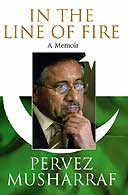
In the Line of Fire
by Pervez Musharraf
Simon & Schuster £18.99, pp368
The well-trodden route for retiring world leaders has long been to exit the world stage and head straight into closed-door sessions with a ghost writer. Getting your memoirs written before the public forgets you, or, even worse, before none of your past colleagues are left in government to embarrass, are key if you don't have the international standing of a Thatcher.
It is rare, though, for a leader to have the time or the inclination to write an autobiography while still in office. But then Pakistan's General Pervez Musharraf does not always concern himself with convention and has released In the Line of Fire a year before the next elections in Pakistan are due, leading many to suspect it is more of a manifesto than a memoir.
The general also set out on an equally curious book tour: his appearance on The Daily Show in America, where he was served green tea and twinkies by comedian Jon Stewart and asked, 'So where is Osama bin Laden?', is now high in the charts of the most-watched YouTube videos.
Musharraf is far from sparing with self-credit in his book - and not just about his political judgment. Everything from his remarkable choice of dog - a small breed as opposed to an ostentatiously fierce, large one - to his abilities as a soldier and an officer is lauded without mercy. This, naturally, becomes a little wearing, as do his constant references to being guided by the hand of fate.
There is a strange moment early on when Musharraf recounts how he got a promotion to division commander in the army. Although he doesn't outline his new duties and responsibilities, he tells how the new job brings him the right to fly little flags on his jeep. It was, says the military leader, ' a source of great pride to me'.
Aside from that insight, there is little introspection from the man whose life has run parallel to Pakistan's existence. He was four at the time of the violent birth of the country in 1947. His family fled Delhi on the night of Partition and made their way to Karachi. He later spent several years of his childhood in Turkey, and it seems that two men figured largely in Musharraf's early ambitions - the founding father of Pakistan, Mohammad Ali Jinnah, and 'Ataturk' Mustafa Kemal.
But it is his enemies rather than his heroes that Musharraf wants us to know about, and while duplicitous India and misguided America are interesting viewpoints, a stream of personal grievances against Pakistani figures who rankle deeply in his mind but whose names won't bother historians makes part of the book tough terrain.
Confusing, too, is Musharraf's account of Kargil, the Indo-Pakistan conflict in the mountains of Kashmir that led to a breakdown of trust and co-operation between Pakistan's civil and military powers in 1999 and to the bloodless coup that pushed him to power - and brought two nuclear powers to the brink of war. The debate still rages in Pakistan today over whether Musharraf had pulled the wool over his government's eyes over what was really happening on the frontline. The Pakistani prime minister at the time, Nawaz Sharif, claims he was duped by his military chief, who was in effect running his own private war in Kargil. In the Line of Fire does little to shed new light on this murky period of history.
This is a hastily narrated memoir with a lot of personal score-settling, but it does give insight into the perspective of the Muslim world on the events of 9/11, the murder of US journalist Daniel Pearl, the ongoing efforts to dislodge al-Qaeda from the borders with Afghanistan and the fight against the 'Talibanisation' threatening Pakistan from the same direction.
