
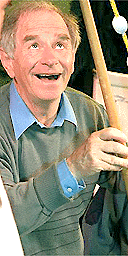
Simon Kent asks: You describe yourself as a "popularizer" of science. How important do you think this role is? Why does the general public need to know about science, in your opinion?
Johnny replies: I feel it is very important to have people popularizing science, as something everyone should be more aware of. You don't have to be an egghead or a genius - you just have to want to know. Sadly, the misconceptions regarding science grow day by day, largely because the people writing for TV and the newspapers have little scientific knowledge, and simply pass on often unscientific information, because they don't have the basic understanding to determine what is right or wrong. Even more worrying are the politicians who glory in the fact that they don't like maths or don't know any science, and so can be persuaded that black is white by lobbyists with an agenda that might well be spurious, to say the least. The watchword in science is, take nobody's word for anything. Question everything: that's what being young should be all about. But you must make the effort to go out and learn the facts for yourself.
Carol McArthur asks: Genetics, cloning, nanotechnology - science currently appears to be entering heretofore unexplored areas at a terrific speed. Which of the current developments in science do you believe will have the greatest impact on our future as a species?
Johnny replies: I think genetics can and will achieve amazing things in the near future. We have to be careful of the moral issues (and cloning will feature strongly in that area). Nanotechnology is all around us already and will soon be applied all over the place, making car and machine parts lighter, for one thing. We can already spray a coating onto road surfaces that eats the "nasties" (of which there are now so few) that come from vehicles and their exhausts. A company called Pilkington's (who invented float glass) can now make glass that will never allow water to form droplets on its surface, so water runs off and takes dirt with it. Self-cleaning glass, as it's known (we have it in our new shower), made the construction of the Gherkin in London possible, and this is only the start of new glass use in buildings. The latest UK-designed hard discs can pack 143,000 tracks in a radius inch. The laser reader has to be held 100 microns from the disc - that's the length your fingernails grow, every one minute and 40 seconds.
Alice Standish asks: Do you think that scientific advances will dig us out of the environmental hole we're in? Or has technology effectively written our death sentence?
Johnny replies: Of course science will dig us out of whatever hole we are in. One of the main problems is that the holes we are told about, which scare half of us to death, are not problems at all for ordinary people, though they do need to be addressed by scientists. The ozone hole at worst, for example, would give someone in Manchester the sunshine they would receive in London ...
Sarah Benedetto asks: Why are science and mathematics declining in popularity in schools today? What can we do to reverse the trend?
Johnny replies: Science and maths are declining in popularity because of the curriculum, which is dull and boring and only geared towards getting children to pass exams. There appears to be little desire to teach kids to think beyond what they are taught; therefore they don't see the power of maths, and don't get their feet wet enough in science to have any idea of whether they have a talent in these areas. Is there a quick fix answer? Yes: we must explain to key stage four kids that up until now their education has been mainly about testing schools and teachers, not teaching them, and now it's time for them to think seriously about what they want out of life, in career terms. It is not too late to start from scratch, irrespective of schools assessments. They must look around, then aim high, and demand the education they deserve. Why? Because they're worth it.
Guy Joseph asks: Are you planning a follow-up to Think of a Number?
Johnny replies: Yes. The title will probably be Science is Measurement. It's about the maths in science, that explains how big, how small, how fast, how slow, how hard, how soft, how hot, how cold. I also want to write a book on the story of human ingenuity.
Steve Brown asks: Which is your favourite science book?
Johnny replies: Bronowski's Ascent of Man - it's the template for any pathway in science.
Elaine Bell asks: Any plans to return to our TV screens?
Johnny replies: I can't get past the commissioning editors! I wrote and presented 23 TV series and am now always rejected as a presenter - the success was through the writing and I could do that for other presenters beside myself. But I have never been asked to write anything!
Martin Powell asks: I have a 10-year-old son and an eight-year-old daughter. Can you suggest any books that might encourage them to take an interest in science?
Johnny replies: You have to search for them. On the internet, try Martin Gardner (who was my inspiration in maths) but only his books written before 1980 - after that they get heavier. Gardner was the hub of world recreation maths for many years. When he dropped his six pages in Scientific American, their sales dropped by a third.
Bill Stevens asks: Which great scientist from history would you most like to meet?
Johnny replies: John Dalton, the colourblind Quaker teacher who lived and taught in Manchester and came up with the idea of the atomic theory, which opened up the path to the periodic table and made possible oil, chemical, biochemical, and materials technology, and gave rise to the pharmaceutical and farming industries - not bad, eh? He also saw and understood the CO2 cycle that balances the world: that every time humans and animals produce CO2, plants (including those in the seas) absorb it and give us back oxygen.
Eleanor Taylor asks: What's your favourite novel? Why?
Johnny replies: I hardly ever read novels, but there are two books that I love. The Mitchell Beazley Joy of Knowledge - a little dated now, but basically the best encyclopaedia ever. And James R Newman's four-volume The World of Mathematics. It sounds heavy, but is often wonderful and simple to follow; there are chapters on 'The Mathematics of Ladies taking Tea', 'Easy Maths and Lawn Tennis', 'Maths in Warfare' and 'Cycloid Pudding'.
