
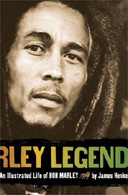
Marley Legend
by James Henke
Simon & Schuster £30, pp64
Sixty four pages? Thirty quid? Don't panic; Marley Legend, published to coincide with the 25th anniversary of the singer's death at 36, is no ordinary book. Rather, it is the latest in Simon & Schuster's series of luxurious volumes that attempts to relate an artist's story through brief - but not flimsy - narrative, photos and painstakingly replicated paper artefacts from their lives. Elvis Presley, John Lennon and, most recently, Bob Dylan have all received this lavish treatment; now it's Marley's turn.
With the beauty and density of last year's Dylan opus, the publisher set its own bar stratospherically high; the new volume, through no fault of those involved in its creation, doesn't quite attain the same heights. How could it? Marley's early life was spent in rural poverty, almost completely uncaptured on film. It is something akin to a miracle, then, that the researchers have uncovered a photo of the child Nesta, as Marley was known to his family, to my knowledge the only extant image of the child. The next best photograph in the book is, tellingly, of the zinc-roofed shack in Nine Miles where Bob was brought up.
Marley - handsome, knowing and armed with that widescreen smile - never made for a bad snap. By the time most of the lovely pictures here were taken (my favourite is of him, all lithe concentration, playing football in Battersea Park, he was already a living, breathing icon. Marley Legend sumptuously illustrates and cements that status.
