
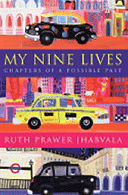
My Nine Lives: Chapters of a Possible Past
by Ruth Prawer Jhabvala
John Murray £16.99, pp288
What exactly have we got here? With this book, the Merchant/Ivory screenwriter and acclaimed novelist Ruth Prawer Jhabvala has given us as close as she dares to an autobiography. But is it close enough? A writer usually strikes a tacit bargain with their reader from the start. Either they are offering fact or fantasy. Jhabvala wants it both ways.
She is hardly the first writer to try to muddy these waters, but her semi-autobiographical novel is more determined about it than most. In My Nine Lives, she sets out, with feline inspiration, a series of nine alternative life stories, each of which she feels she could have lived. All the histories in this book, we are playfully informed at the outset, are a mixture of truth and fable, all 'chapters of a possible past'. It proves a disconcerting basis on which to go forward.
'I tell nothing but lies,' the author once confessed in an interview but, in fact, it is more probable that every piece of fiction Jhabvala has written so far, from her Booker-winning Heat and Dust in 1975 onwards, has drawn quite heavily on her own cross-cultural dilemmas. Born in Germany to Polish-Jewish parents, she was educated in England, married an Indian and now has dual American/British nationality.
Predictably, the problem of handling identity when there are so many competing loyalties has been the habitual theme of her work. And now, in her first novel for nine years, Jhabvala has ducked the chance to be candid about herself in favour of producing short stories that will fill in at least part of the emotional and cultural picture. It seems she can only approach the subject of her own confused roots elliptically, through fiction - or perhaps she fears her creative juices might evaporate if she were to tackle it head on.
The nine lives described range from women who feel emotionally pulled towards India, to those who have rejected it, from those who have embraced their mixed heritage, to those who are still struggling to accommo date it. Repeatedly, whether in New York, London or India, an array of influential Middle European relatives shapes the central characters' sense of self.
The wider contexts of politics and economics are generally blurred in Jhabvala's tales. She is interested primarily in private lives. Like Henry James and EM Forster, the two writers whose work she has successfully adapted for the big screen, her focus is on the personal revelations and revolutions that affect relationships with places and people.
Jhabvala, however, does not make judgments about her characters. Where James covertly paints an over-arching argument while he appears to be giving us a mere comedy of manners, Jhabvala has less to say.
She is perhaps closer to Forster in her search for a spiritual heartland: she does not necessarily believe it really exists, but she is interested in a shared human yearning. Several of her characters in this book are looking for spiritual guidance, whether from poet-saints, as in the first story 'Life', or from Indian philosophers, as in 'Pilgrimage', the last story. And in Jhabvala's opening apologia, she talks too of an endless, vain quest for a particular person. 'This may have been a person I have looked up to, or been in love with, maybe even for some sort of guru or guide. Someone better, stronger wiser, altogether other... does such a person exist and, if so, does one ever find him?'
This is the key sentiment and it echoes words used most potently by Forster to describe the quasi-religious, quasi-sexual longing for a one 'friend', above all others, that inspires the friendship between Fielding and Aziz in A Passage to India, a rare example of a Forster book not adapted for the screen by Jhabvala.
