
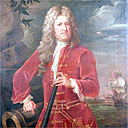
Picture courtesy of the National Maritime Museum Photograph: National Maritime Museum
The distinguished naval officer has a fine ruddy look, as if he might well reach for a whisky bottle in times of stress. There's a grim set to his jaws too, as if they could open to bellow: "Sea gherkins! Baboons! Filibusters! Bagpipes! Gallows fodder!" as Captain Haddock does.
As Captain Haddock repeat edly boasted, his ancestry was noble and illustrious - and it is revealed in an exhibition opening tomorrow at the National Maritime Museum in Greenwich, south-east London.
The exhibition, The Adventures of Tintin at Sea, marks the 75th anniversary of Hergé's immortal boy reporter. Tintin had already been galloping around the world for 12 years with his faithful dog Snowy when the Belgian cartoonist created the drunken, vainglorious, but ultimately brave and noble Captain Haddock as his travelling companion.
Long after he created Captain Haddock and wrote The Secret of the Unicorn, in which the ancestral Haddocks are a crucial plot point, Hergé was amused to discover that there really was a distinguished English seafaring family of Haddocks.
A portrait of Admiral Haddock goes on display at the museum this week for the first time, as part of the exhibition.
The real admiral came from a shoal of Haddocks, all buried in the churchyard at Leigh-on-Sea in Essex: his father, grandfather, brother, cousin and son all went to sea, many serving in the navy with distinction.
The portrait came to the museum from a collection once displayed in the Painted Hall of the nearby old Royal Naval College.
Although only one book, The Black Island, was set in Britain, Hergé (real name Georges Remi, who made his nom de plume from his reversed initials) often visited Britain. The museum recently found a 1950s photograph showing him on the deck of Captain Scott's ship Discovery when it was moored on the Thames.
The exhibition includes some of his earliest drawings, which acted as his release as a schoolboy from what he called "a remarkably grey" middle -class suburban childhood in Brussels.
· The Adventures of Tintin at Sea is at the National Maritime Museum, Greenwich (020 8312 8577, www.nmm.ac.uk) from tomorrow until September 5.
