
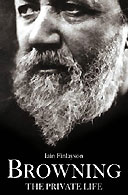
Browning: A Private Life
by Iain Finlayson
HarperCollins £30, pp758
WH Auden observed that the private papers of an author, if they are to satisfy the public, must be twice as shocking and unexpected as his public books. In the case of Robert Browning, the published work is far from shocking, if occasionally unexpected; the private papers, on which Iain Finlayson leans heavily to swell his reverential tome to daunting proportions, are rarely either. So Finlayson is up against it.
He has also set himself the uphill, if commendable task of suggesting that Browning was a better poet, and a more interesting subject for biography, than his wife, Elizabeth Barrett. By painting her as a sickly, neurotic harpy, lurching between drugs and spiritualism to enliven her selfish, pampered existence, Finlayson does manage to persuade us that her far less worldly husband had the patience of a saint (or else that love, as most of us already know, moves in mysterious ways). But he winds up defeating his own ends, albeit inadvertently, by reinforcing our presupposition that the most interesting thing about Browning was Barrett.
After their clandestine marriage and elopement in 1846, the couple were together for a mere 15 years of Browning's 77-year life. But the day-to-day details of that shortish span, spent largely in Italian exile, merit the longest of Finlayson's three immense sections, serving as an often wobbly bridge between Browning's pre-Barrett aspirations to serious-minded poetic respectability and his three post-Barrett decades as an increasingly incomprehensible spent force.
'I shall live out the remainder [of my life] in her direct influence,' Browning wrote to his sister Sarianna after Elizabeth's death. 'The future is nothing to me now, except inasmuch as it confirms and realises the past.' For all a few mild flirtations, Sarianna became the nearest he ever got to a replacement; she acted as his companion and long-suffering soulmate while undertaking the tricky role of surrogate mother to his son, Pen - short for Pennini, as the boy chose to call himself after his parents landed him with the name of Wiedemann.
For reasons best-known to herself, and left that way by her biographer, Elizabeth chose to raise poor Pen as a girl, dressing him in satin, ribbons and dainty shoes, letting his hair fall past his shoulders in long ringlets. A forlorn photograph of mother and androgynous son leaves us unsurprised that the boy turned out to be a feckless neurotic, even once Browning cut his hair and bought him some long trousers after his mother's death. Disappointing his father by failing to get into Balliol, Pen eventually became a mediocre painter, flexing his maternal genes with some shrewd property investments.
It was apparently a Polidoro painting of a gallant knight rescuing a damsel in distress from a dragon that moved 34-year-old Browning to commit social suicide by rescuing the semi-invalid Elizabeth, six years his senior, from her virtual house arrest in Wimpole Street. Was it really worth it? He evidently thought so, though Finlayson fails to persuade the reader otherwise. Elizabeth's spaniel-like husband had to put up with her snobbish support for Louis Napoleon as well as her addiction to opium and her long, tedious flirtation with a quackish American medium.
We learn more about bonnets than sonnets as Finlayson describes their daily life in far more detail than anyone can ever want to know; poems occasionally get written, by both husband and wife, but one is often left wondering how (and, in most cases, why) amid all their ceaseless socialising (with modish expats), self-indulgent travelling, incessant money worries and baffling mutual admiration.
'I hope they may understand one another - nobody else could!' said Wordsworth on hearing of the Brownings' union. With the exception of the early, out-of-character Pied Piper, Browning never really escaped the charge of almost wilful obscurantism, though there are certainly some noble insights and touching sentiments in the poems collected under the title Men and Women.
But his marriage to Barrett, one cannot help concluding, robbed English letters of the more eloquent and substantial body of work this intelligent, sensitive soul could surely have produced. Instead, he ended (as he had begun) almost risibly opaque, each successive work failing to impress or indeed sell as surely as his late wife's went into their umpteenth editions. Lionised in old age as a cult figure (to his faux embarrassment) by a group of literary anoraks who formed a Browning Society, he lived to see it fade all too swiftly into oblivion. There is no more forlorn fact in this book.
Apart, perhaps, from such details of his marriage as Elizabeth's threat to leave him when he shaved off his beard - and his immediate compliance, in this as in so many other cases, with her every whim. For this reader, it was often a close call between aching for him to yell at her and praying he would slam his study door and write a decent poem.
In his prologue, Finlayson makes large claims for Browning upon which, cumulatively, he fails to deliver. He may have such luminaries as Henry James to cite (all too frequently) in his support, but there is little new or arresting material in this book, which relies more openly than most on previous lives of husband and wife in its vain attempt to rescue Browning from Barrett's long, if slender shadow.
