
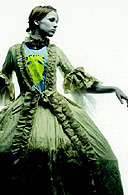
Fashion at the Edge: Spectacle, Modernity and Deathliness
by Caroline Evans
Yale £30, pp326
Remember those extraordinary adverts that Jurgen Teller shot for Jigsaw menswear of a man falling to his death from a high building? Or Hussein Chalayan's chairs and tables that folded up into dresses, highlighting the way refugees squirrel away their possessions in times of war?
In her sumptuous new book, Fashion at the Edge, Caroline Evans argues that late-1990s fashion, with its preoccupation with death, trauma and exile, actually embodied many of our own anxieties about Western consumer culture. To speak in psychoanalytic terms, it represented the return of the repressed. We may regard Martin Margiela's deconstructed mouldy garments or Alexander McQueen's dresses made from two thousand glass microscope slides or razor shells as unwearable. But for Evans they show fashion as both spectral and commercial.
The most interesting practitioners go close to the edge. Think of Andrew Groves's 1998-9 collection based on the Troubles in Northern Ireland. Or Alexander McQueen's Highland Rape collection, which far from violating women, highlighted the 'genocide' of the Clearances.
Fashion has always played a leading role in constructing images and meanings during periods of rapid social, economic and technological change. It can act out instability or loss, or it can stake out the territory of new social and sexual identities. For Evans, fashion is a kind of historical scavenging. So we see how Galliano's Sphinx collection borrowed from Aubrey Beardsley and Gustave Moreau, while the Versace Medusa is both Judith and Salomé. And who would have thought Millais's Ophelia was the first watery supermodel?
Although Fashion at the Edge celebrates fashion, this is no backslapping hagiography. Evans expects you to know your cultural references as well as your hemlines (her sources include Marx, TS Eliot, Freud, Foucault). In no particular order, she explores the development of European mercantile capitalism, commodity fetishism, and the politics of production (the way fashion emphasises consumption at the expense of production, making the latter classically invisible in Marxist fashion).
It's a rich brew, but if you get weighed down by the cultural theory, there are the dazzling photos. Evans can be a demanding writer, but she is not immune to showstopping excess. For her, fashion is about masquerade. And she likes a bit of camp. The chapter on Glamour is an exploration of fashion's motif of 'women for sale' - but there are great visuals of Julien Macdonald's near-naked showgirls and Donatella's sapphic Eurotrash.
And who says fashion hasn't got a sense of humour? In the late 1990s, a cash-strapped Victor and Rolf flyposted Paris declaring: 'Victor & Rolf on strike'; while Russell Sage constructed a dress made from £50 notes. Best of all is Diesel's 'Stay Young/Save Yourself' campaign, where models had silicone masks for heads, satirising our obsession with Botoxed perfection.
