
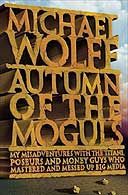
Autumn of the Moguls: My Misadventures with the Titans, Poseurs and Money Guys who Mastered and Messed Up Big Media
by Michael Wolff
Harper Business £18.99, pp336
There are many unpromising things about Michael Wolff's extended thesis on the decline of the global media industry. For a start, it has one of those don't-buy-me titles. Then there is the narrative decision to base it around the organisation of a business seminar. And last, but not least, the statistical probability that only one in 100 books written about the media industry is ever more than just about readable.
But Autumn of the Moguls makes the 1 per cent grade of business literature that transcend the dutifully competent or ambitiously inept. Wolff chooses an epic theme for the book: a demonstration that all major media organisations are failing, that they are run by executive vessels empty of ideas and inspiration, and peopled by individuals who are as mad as hell and don't want to take it any more. The commoditisation of media, the rise of Wall Street and the encroaching new technologies have taken the industry from one that aped governments - maybe surpassed them - in its civic pretension, to a moronic inferno of clueless dealmakers.
In other hands, this argument could easily be rendered as dry as dust. But Wolff is on top of his subject, a stylish writer of enormous wit, if a little prone to showing off. His earlier book, Burn Rate, was a minor masterpiece and his readable media column in New York Magazine is routinely one of the best in the US press. In Autumn of the Moguls, he has taken his Rolodex and tried to turn it into A Dance to the Music of Time. There's a dizzying cast, each with a tale attached.
Wolff, despite being well aware of his talents, clearly has some 'self-loathing' over how he relates to this world of rarefied characters and hangers-on. The central yarn in the book seems to be Wolff's opportunity to interview Rupert Murdoch live on stage (via a satellite link). Despite setting up the premise that the mogul as a central powerful character is all but gone, something strange happens to Wolff in the presence of Murdoch. He admits having a 'semi-crush' on the septuagenarian. At a party with Murdoch, he decides not to leave the table to empty his bladder in case someone pinches his seat at Murdoch's elbow.
Wolff is dazzled, too, by US media owner Barry Diller, who he says could be the 'last action mogul', though the author adds: 'He had achieved a greater thing: to be wholly in the game and yet entirely independent... what's more, he had slipped the bonds of true, mortal responsibility.' He doesn't see the presence of these two pin-ups as a contradiction to his theory - Murdoch is in the autumn of his life, and Diller, he argues, has gone 'post-mogul'.
But the author is at his best when analysing the weakness of his subject matter through biting observation. He is cruel but undoubtedly accurate about Tina Brown and Harold Evans's fading stock in New York. He writes about domestic goddess Martha Stewart with an incisiveness which not only makes you laugh but also demonstrates truths about business remarkably well. Wolff is clearly delighted by the Stewart phenomenon while describing her real persona as 'a money-grubbing, I-take-what-I-want scumbitch', adding: 'Being your own brand requires a nastiness and greediness and megalomania that make prosecution always a possible outcome.'
Wolff talks about David Halberstam's The Powers That Be, the influential book about the power of postwar media. One feels that he is striving to define his era as authoritatively as Halberstam did 25 years ago. His book does not scale these heights, but for a documentary of a declining, fragmenting, tarnished and tired business it is a pretty good description of the beginning of the end.
