
The following correction was printed in the Guardian's Corrections and Clarifications column, Thursday July 10 2003
We said below that during the reign of Elizabeth 1, more than 35,000 people were sent to the scaffold. The more commonly accepted figure for Catholics executed for being Catholics (or supposed treason arising from their Catholicism) during Elizabeth's 45-year reign is about 200.
-----------------------------------
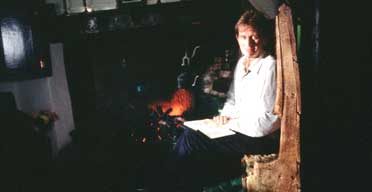
In the recent Great Britons series, the legendary theatre director Peter Brook suggested that the biography of Shakespeare didn't matter one jot, it is only the plays that count. The film-maker and life-long Shakespeare fan Michael Wood thinks that is rubbish. Well, he would wouldn't he, because he has just completed a four-part BBC2 series called In Search of Shakespeare, which attempts to put flesh on the bare bones of Shakespeare's life and show that the world's greatest playwright was very much a product of his time - a society in a state of revolution split between an old-world Catholic sensibility and the Protestant new order, the medieval and the modern.
The contemporary poet and playwright Ben Jonson declared that Shakespeare was "not of an age, but for all time". Wood sets out to prove that although Johnson was right in the second, he was wrong in the first: Shakespeare - and the plays that he wrote - were in fact very much a product of the turbulent era in which he lived.
Amazingly, while Shakespeare's plays have been regularly shown on television and there have been dramas and documentaries speculating on their authorship, there has never been a full-blown television biography of the national icon. Perhaps it is not so surprising, because so little is actually known about his life, particularly the early years.
When Wood first posited the idea, one TV executive sniffed that it would be rather dull as you would only be able to film in Stratford-upon-Avon and at the Globe, while an eminent history scholar pointed out that it was going to have to be a very short series given the paucity of solid facts known about Shakespeare's life. That certainly hasn't stopped Wood, whose series Conquistadors and In the Footsteps of Alexander the Great have not only been classy popular TV that never let a lack of facts get in the way of the spectacular scenery, but have also been acclaimed by scholars for their historical accuracy.
Even so, Wood admits that the first episode of In Search of Shakespeare in particular, which takes Shakespeare up to the age of 19 and his marriage to Anne Hathaway, presented "a huge technical challenge because we only have three facts about his early life".
So Wood turned detective and the result is a history series with a touch of Inspector Morse, a racy, pacy investigation which uses primary sources often ignored by Shakespearean scholars to uncover information about a shadowy figure and the world he lived in, and to tell a story of family disgrace, personal tragedy and retrieval of reputation. There will be some who say there is too much speculation and not enough fact, and sometimes it does indeed seem like chasing shadows, but Wood suggests that perhaps Shakespeare had good reasons for being so guarded and private, in an era when spies were everywhere and any dissent from the ascendant Protestantism was ruthlessly wiped out. During the reign of Elizabeth I, more than 35,000 people were sent to the scaffold. Shakespeare and his family were not untouched.
The style of In Search of Shakespeare may be lush and romantic, more Shakespeare in Love than The World at War, but what makes it radical is the way it rescues Shakespeare from the heritage industry.
"Of course it's lush," says Wood. "It is a series about England. Shakespeare is about Englishness and the national narrative, but in this case the narrative is not quite what we think it is. The cunning when making this kind of series is to make people feel warm and good and then take them somewhere unexpected, into a world that's different from the one they thought they were in."
"We have this image engraved on the national consciousness of William Shakespeare as a ruddy man quaffing his ale above a half-timbered cream-tea shop in the Midlands in the reign of Good Queen Bess. I wanted to show that it was much more complicated than that."
Much, much more complicated: there will almost certainly be plenty of people unwilling to incorporate into the national narrative the idea of Shakespeare as a quietly sly Catholic dissident, whose plays reflected a loyalty to the traditions of his parents and grandparents at a time of cultural revolution, when a great mass of the population were being forced to wipe their memories.
If In Search of Shakespeare approaches history sideways on, offering a history of an era told as a portrait of the artist as a leading representative of his time, it is also unusual for the TV history genre in that it completely eschews the historical re-enactments that have become the staple of such series. Instead of actors dressed in big ruffs, Wood offers us real-life, modern-day commentators who offer a direct conduit between our own age and Shakespeare's. When a glover talks about his trade, the same one carried out by Shakespeare's own father, and when Stratford-upon-Avon's town councillors point out the similarities in the governance of the town to Shakespeare's day, it is as if the years have melted away. At its very best, In Search of Shakespeare makes you feel that you can reach through your TV screen and touch history.
Of course, in many ways Peter Brook is right, it is Shakespeare's plays that are important, not the life story of the man himself, and there is something a little curious about a series about a playwright that for the first two episodes makes very little mention of the plays themselves. Wood entirely accepts that we can watch Twelfth Night without having any need to know about the contemporary allusions or why Shakespeare wrote the plays, but argues that it can be a richer experience if we do. "It makes Shakespeare more understandable," he says. "If we know that he came from a Catholic family, we can understand why he rewrote anti-Catholic plays such as King John, and how Lear could be understood by its contemporary audience as a spiritual commentary and Pericles as a spiritual allegory." Wood also dismisses the argument that In Search of Shakespeare represents the respectable face of our celebrity-obsessed culture, which makes us more interested in the writer's life than the plays he wrote.
"I don't think there is anything wrong in trying to locate the writer in his own time. Omnibus and Arena used to do that kind of thing a lot. Of course, there is a pressure when making a series like this not to talk about the influence of Puritanism on Measure For Measure, but about the dark Lady of the Sonnets. The truth is that the average punter probably just wants to know whether Shakespeare loved his wife and whether he was gay or straight."
And he concludes: "To a certain extent, you have to go with that. I am the first person to accept that TV history is primarily entertainment. But that doesn't mean that you can't dig deeper too, surprise yourself and the viewer."
· In Search of Shakespeare begins on Saturday June 28, 9.10pm, BBC2
