
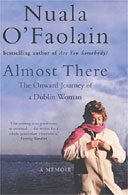
Almost There
by Nuala O'Faolain
Michael Joseph £14.99, pp288
When she was in her mid-fifties, Nuala O'Faolain explains, she felt that middle-age was too bleak to talk about. She had no child, no lover 'and no other creation'; she believed passionately that her life had been a failure. 'I was so dull that even a description of my dullness would have had too much life in it.'
Paradoxically, this is an enticing hook for the opening of a memoir, not least because she also confesses to having had a slew of male lovers in the past and to having just finished a 15-year relationship with a woman. It becomes more interesting still if you know that an introduction that she subsequently wrote to a collection of her Irish Times columns, a description of the regret that filled her life and its roots in her childhood, became a bestseller at home and in America, where there is an avid market for Irish misery-memoir.
Now in her early sixties, O'Faolain has written a follow-up. In the years since the publication of Are You Somebody? she has written a novel and moved to America; she has become a rich woman and, it emerges, a loved one. But a tone of mournfulness still drifts through her writing like a mist.
Sometimes this borders on the irritating. Why does she persist in letting her long-dead mother mess up her life, even if she did prefer drinking to looking after her nine children? O'Faolain is 63 and hugely successful: isn't it time to get a grip? And then, more disturbingly, there's her current jealousy of her lover's eight year-old daughter. Her resentment of this child is so churlish, so self-regarding, that it makes one doubt the virtues of candour. Still, candid is what O'Faolain determinedly is, and if she is set on being unflinching, I suppose her readers will sometimes have to flinch for her.
The real point about O'Faolain, though, is that she writes with such precision and individuality that she could make the copy on the back of a cornflakes packet compelling. And her subject matter isn't so far off that. She deals in the ordinary, daily stuff - moths that stumble through the window on warm air, the silky feel of sand under a hedge on a Donegal beach, where it has never been warmed by the sun. But she handles her material with such particularity of perception and with a way of letting the reader in on the emotion, that it's pretty irresistible. She says that she could easily write 1,000 words for a newspaper column on a phrase like 'grist to the mill' and it's clear she has great fluency, but her facility is combined with carefulness: the structure deftly leads you forwards; there is craft underneath the moreishness.
Almost There is much preoccupied by the differences between America and Ireland, for which her feeling is 'intensely physical but full of emotional mistrust'. Despite a claim that this book is predicated on 'the sorrow of believing that it is too late for anything good to happen and the joy, therefore, when something good does', O'Faolain's fundamental belief appears better summed up when she says: 'I don't believe that life offers us many consolations of the same size and weight as it offers us hurts.' By the end I had a hunch she didn't really want to be happy, because she found unhappiness much more interesting and useful.
She considers the possibility that the success of many contemporary memoirs, including her own, may have less to do with the specifics of the author's life than with underlying rhythm, 'and readers graft their own emotions and experience onto that rhythm beneath the overt text'. She is nothing if not a rhythmic writer and this is why Almost There is not a remotely depressing book: the prose is filled with the sap of finely expressed insight.
