
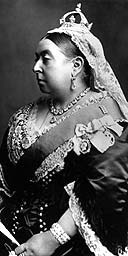
"My loyalty, I hope, will not be questioned when I say that photography has not hitherto flattered the appearance of the Royal Lady." So wrote a correspondent who has come down to history only through his pseudonym - the Lounger - in the British Journal of Photography in 1865.
But a new book shows that Queen Victoria, best known for her stern face, severe hairstyle and general dumpiness, knew all about manipulating the press and adjusting her image for the public, a century before our supposedly more media-savvy monarchy.
The book - Queen Victoria, First Media Monarch, by John Plunkett of Exeter University - shows that not only did the queen have her own spin doctor, or court newsman as he was known, but that she, or her photographers, were not above slimming her stately figure, touching out her double chins or increasing her height by making her stand on a box for official photographs.
Negatives of pictures taken by the society photographer Alexander Bassano in 1882 are revealed in the book to show the marks of retouching, slimming down the ample waistline, removing wrinkles, adding hair and drawing in the regal profile to produce a statuesque but trimmer figure.
In Mr Plunkett's words: "Curves have been created where none previously existed ... a moderate proportion of Victoria's face has disappeared under the gentle touch of the retoucher's pencil... the final picture shows a queen who looks more youthful than her 62 years."
It was not entirely successful. Photographic News commented in 1897 that "when you are the possessor of more than one chin, profile IS perhaps the best".
The royal image was carefully marketed by Buckingham Palace too. For Victoria's official diamond jubilee photographs the palace deliberately did not seek copyright protection, making the pictures freely available to all who wanted to copy them or hang the images on their walls.
Photographers could make big money from marketing their pictures. The first of the queen and her husband, Prince Albert, in 1860, earned the photographer John Edwin Mayall the enormous sum of £35,000, with 60,000 copies of his royal album sold at four guineas each within days of publication.
The diamond jubilee was the first royal event, maybe the first news occasion, to be filmed by movie cameras, with the newsreels shown as far and wide as New York, Melbourne, Cape Town and Paris.
The book also shows that there was a huge appetite for royal news and that reporters seem to have behaved no better then than they are reputed to do now. The deeply conservative Morning Post was renamed the Fawning Post by rivals in the 1840s. When the Queen died in 1901, reporters waiting outside her home at Osborne, on the Isle of Wight, were censured for their raucousness - and for inventing interviews with the royal doctors.
· Queen Victoria, First Media Monarch, by John Plunkett, OUP £20.
