
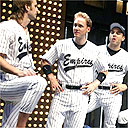
It is a measure of our infatuation with America that Richard Greenberg's play about baseball gets its world premiere at the Donmar: hard to imagine any New York theatre returning the compliment with a show about cricket. But my basic objection to Greenberg's play is that, for all its wit, it never quite decides what it is really about.
You could take it as a study of sporting gayness since its hero, an iconic African American baseball star called Darren Lemming, comes out early in the action; and Greenberg captures well the uneasiness of his colleagues on the New York Empires team. But since Darren's declaration leads to homophobic jibes from a hillbilly pitcher and indirectly causes an on-field death, you could deduce that Greenberg is arguing that athletes should stay closeted.
But I suspect Greenberg's real desire is to celebrate the mythic power of baseball itself; and certainly the play's most riveting character is Darren's business manager, himself a repressed gay, whose life is transformed by the great game. Played brilliantly by Denis O'Hare as a nervous klutz who almost falls off his chair in Darren's presence yet persuades him not to abandon his career, this character vindicates the claims made for baseball as "the metaphor for hope in a democratic society".
Yet even as Greenberg celebrates the hold baseball exerts over the American psyche, he also charts its destructive aspects. A multiethnic team, such as the Empires, embraces African Americans, Hispanics, Scandinavians and Japanese yet Greenberg suggests they all live in their own separate, lonely worlds. A racist bigot is taken back on board because he is a good pitcher. And even Darren himself, for all his heroic status, has no secure sense of identity. Asked by his business manager "what do you give a shit about?" he cautiously replies "let me get back to you on that".
In short, Greenberg asks us to accept baseball as a secular religion while at the same time suggesting it is filled with ignorance, prejudice and egos as inflated as the salaries received. But, although the play strikes me as self-contradictory rather than intriguingly ambivalent, it is well directed by Joe Mantello and impressively acted by its all male cast. Daniel Sunjata endows Darren with the right aura of privileged solitude, Neal Huff is equally good as his best friend secretly ashamed of his academic intelligence and Frederick Weller is deeply unnerving as the manic southerner who uses his pitcher's position to commit murder. But, while I welcome the play as an addition to the meagre catalogue of dramas that deal with sport, I do not feel that Greenberg has hit a home run or worked out exactly what he wants to say.
Until August 3. Box office: 020-7369 1732.
